

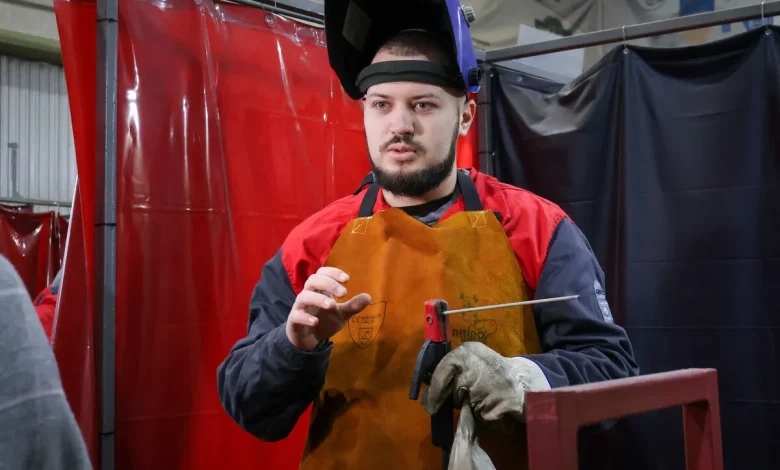
24-year-old veteran Yevhen Karpiv, who lost his leg during a combat mission in Donetsk region, is acquiring a new profession in Lviv. The soldier is studying to become a welder free of charge at the Interregional Higher Vocational School of Motor Transport and Construction and plans to continue working in this field.
Yevhen is doing his practical classes in the training workshop together with other course participants. Here he is mastering the basics of manual arc welding: learning how to strike an arc, make an even weld, hold the electrode correctly and control the distance and angle. His workstation has not been additionally adapted – the veteran works on an equal footing with others, and the prosthesis does not hinder him during training.
Karpiv is originally from Kirovohrad region. He joined the army back in 2019. He studied for four years at the National Army Academy and, after graduating in 2023, chose to serve in the Air Assault Forces. Under his posting he was assigned to the 79th Separate Air Assault Brigade, where he was commander of an engineer-sapper platoon of an airmobile battalion, and later served in the brigade’s engineering support group.
On the night of 12–13 March 2024, while on a combat mission near Novomykhailivka in Donetsk region, he stepped on an explosive device. As a result of the explosion, Yevhen instantly lost his leg above the knee. After administering first aid to himself and with the support of a fellow soldier, he was evacuated to a medical facility. What followed was prolonged treatment, complex rehabilitation, fitting of a prosthesis and relearning to walk with the help of rehabilitation specialists.
After being discharged from service, the veteran began looking for his place in civilian life. The idea of trying welding was suggested by his comrade-in-arms Taras, who had worked as a welder before the war and often shared memories of this job. Interested in the profession, Yevhen started looking for opportunities to learn it. In time he met veteran Oleksii Hushchyn, now the chief specialist at the Department of Veteran Partnerships and Public Relations of the Veterans Affairs Office of Lviv City Council, who told him about free courses at the vocational school in Lviv.
Yevhen filled in an application form and is now undergoing training. After completing the course, he plans to look for a job in the welding sector, although he has not yet chosen a specific workplace, but he has already settled on his direction.
In Lviv, short-term free retraining courses have been organised for veterans, internally displaced persons and people affected by the war. The Interregional Higher Vocational School of Motor Transport and Construction runs two programmes: welding and installation of engineering systems (installer). The training is funded by the Swiss government.
According to the school’s director, Nazar Zakal, there are currently two groups studying here: 15 people are learning welding, and another 14 are mastering the installation of engineering systems. The courses last three months and combine theoretical classes, practice in the institution’s workshops and on-the-job training at enterprises. This approach allows participants not only to acquire professional skills, but also to establish contacts with employers and improve their chances of employment.
Upon completion of the programmes, participants receive certificates and may also sit an exam at a qualification centre and obtain a state-recognised certificate. According to the institution’s management, such courses have been held here since 2022, and school representatives additionally visit rehabilitation centres, where they run workshops, including with the use of a virtual reality welding simulator.
Vocational education in Lviv for veterans is not limited to technical specialities related to welding. There is an opportunity to study free of charge to become cooks, bakers, confectioners, car mechanics, motor vehicle technicians, security systems installers, to learn how to operate computer numerical control machines and to acquire other professions. When choosing a field, the individual needs of the person and their physical capabilities are taken into account, including for veterans with different types of amputation.
Bohdan Ivanus, head of the Vocational Education Department of the Department of Education and Culture of Lviv City Council, said that a profession is selected so that a person can realistically work in it. For example, if a veteran with a double amputation of the lower limbs wants to go into carpentry but working with large pieces of timber is too physically demanding, he is offered options related to carving or restoring small wooden items. This makes it possible to combine a person’s interests with safe and accessible working conditions.
The Department of Education and Culture of Lviv City Council notes that they plan to expand opportunities for vocational training for veterans. In line with the new Law of Ukraine “On Vocational Education”, from next year they expect to have additional tools for free training and retraining of citizens under the conditions set out in the law.
Yevhen Karpiv advises service personnel returning to civilian life not to be afraid to try new fields and to talk more with comrades who have already gone through the adaptation process and managed to find themselves in a different sector. As for himself, he is now taking his first steps in his new profession, continuing his studies and practice, and is determined to build his future life in his chosen field of welding.