

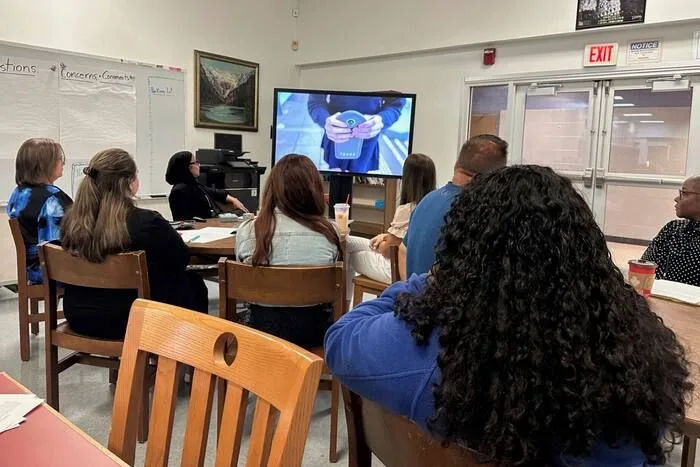
In recent years, dozens of US states have introduced restrictions on the use of mobile phones in schools, hoping in this way to improve pupils’ concentration and academic performance. However, new research indicates that while such bans do have an effect, it is fairly modest.
According to the Phone Free Schools State Report Card, more than 40 US states have passed laws that restrict phone use during lessons. The specific rules are often left to schools’ discretion, so the picture across the country is mixed: in some places phones are completely locked away in special pouches, elsewhere pupils are required to keep them in their rucksacks, and in some schools phones are formally banned but compliance is barely monitored.
A large study by the Harvard University Centre for Education Policy analysed test results for 3.3 million pupils in 4,600 schools over five academic years. In schools with strict restrictions — including a requirement to keep phones in locked pouches throughout the day — researchers recorded “moderate” improvements in attainment in maths and reading compared with similar schools without such rules. They estimated this to be equivalent to roughly an extra one to two weeks of learning per year.
The authors stress that test scores worldwide have been declining since 2013 — roughly the point at which smartphones with access to social media became widespread. They suggest that systematic restrictions on phone use may gradually offset part of this loss, but are unlikely to restore performance to previous levels quickly.
Another study, published by the US National Bureau of Economic Research, reached more cautious conclusions. It compared schools with phone bans to tens of thousands of other institutions, using other standardised tests, GPS-based data on phone activity, teacher surveys and information from Yondr, a company that supplies locking pouches. The authors found only slight positive changes in older pupils’ results, mainly in maths, and overall described the impact of bans as “close to zero”.
Education economist Thomas Dee of Stanford University, one of the study’s co-authors, believes both pieces of research point to a similar conclusion: the initial results of phone bans are rather disappointing and leave many questions unanswered. He suggests that pupils may simply be distracted by other devices, such as school laptops, or that a significant part of the damage to learning is caused by smartphone use outside school.
Psychologist Jean Twenge of San Diego State University notes that the mere existence of a formal ban does not guarantee it is actually enforced. According to her, in many schools phones continue to be used extensively despite the official rules, and teenagers find ways to get round the restrictions — from “spare” phones to dummy objects in cases. Even without smartphones, pupils often have internet access via other gadgets.
Researchers also point out that much of the impact of smartphones on learning may fall outside school hours — for example, when teenagers use social media while doing homework or stay up late watching videos. At the same time, scientists currently have no access to detailed data on individual children’s activity on social networks, which is held by technology companies, so they cannot fully assess this factor.
In the end, the authors of the studies agree that strict phone restrictions in schools can deliver some, but only a small, improvement in academic outcomes. They see such measures as a relatively low-cost way of adding a notional “week or two” of learning per year, but emphasise that phone bans alone will not solve all the problems associated with falling attainment in the digital age.