

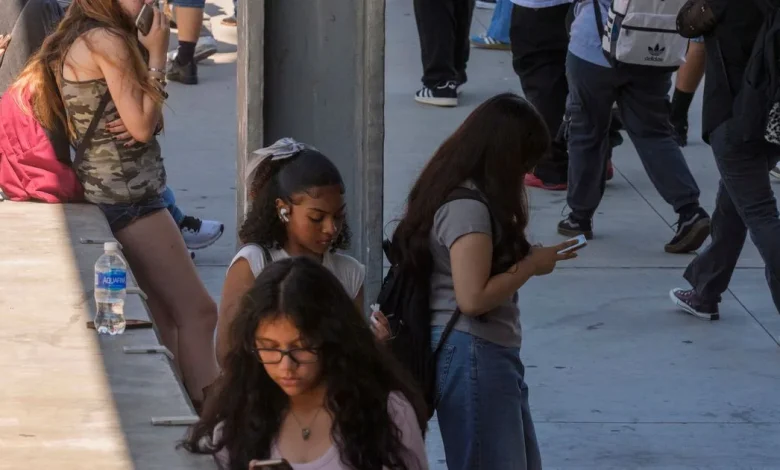
New research in the United States shows that strict bans on mobile phones in schools deliver only modest, albeit positive, effects on pupils’ academic performance.
According to the Phone Free Schools State Report Card, over the past few years more than 40 US states have passed laws restricting the use of mobile phones in schools. Specific rules are often set by the schools themselves, resulting in a patchwork of requirements and enforcement across the country.
A large-scale study by the Harvard University Centre for Education Policy found that schools with strict restrictions — where pupils leave their phones in special locked pouches for the entire school day — show “modest” gains in academic outcomes compared with similar schools without such rules.
The study analysed maths and reading results for pupils in Years 4–10 over the past five academic years. The additional progress is estimated to be equivalent to roughly one to two weeks of learning per year. This is about half of the average annual decline in test scores recorded since smartphones became widespread.
The study’s author, Harvard professor Thomas Kane, stresses that phone bans have a positive effect but are not a “magic bullet”: the loss of learning outcomes took years to accumulate, so recovery is also gradual.
At the same time, another study, released in May by the US National Bureau of Economic Research, concluded that strict school phone bans have an “almost zero” impact on final grades. It compared schools with restrictions to tens of thousands of other institutions, using other standardised tests, GPS data on phone activity, teacher surveys and information from Yondr, a company that supplies locking pouches.
This study also found modest positive changes in the results of older secondary pupils, especially in maths, but its authors from Stanford, the University of Michigan, Duke University and the University of Pennsylvania refrain from drawing firm conclusions about the overall benefits of bans for learning.
Education economist Thomas Dee of Stanford University notes that the initial results of school phone bans are rather disappointing and leave many questions unanswered. He acknowledges that the Harvard study points to a possible build-up of effect over time, but considers current estimates too small and too sensitive to support long-term predictions.
Among the possible reasons for the modest results, researchers point out that pupils may be distracted by other devices, such as school laptops, or that the main harm occurs outside school — through excessive phone use at home.
Psychologist Jean Twenge of San Diego State University notes that a formal ban does not necessarily mean it is enforced in practice. According to her, in many schools phones are still everywhere despite official rules, and teenagers find ways around them — from “spare” phones to dummy devices in cases.
Experts also stress that learning is affected by smartphone use at home: if children have a phone nearby while doing homework, this can reduce their concentration. At the same time, researchers acknowledge that they currently lack access to detailed social media data to directly link time spent online with academic outcomes.