

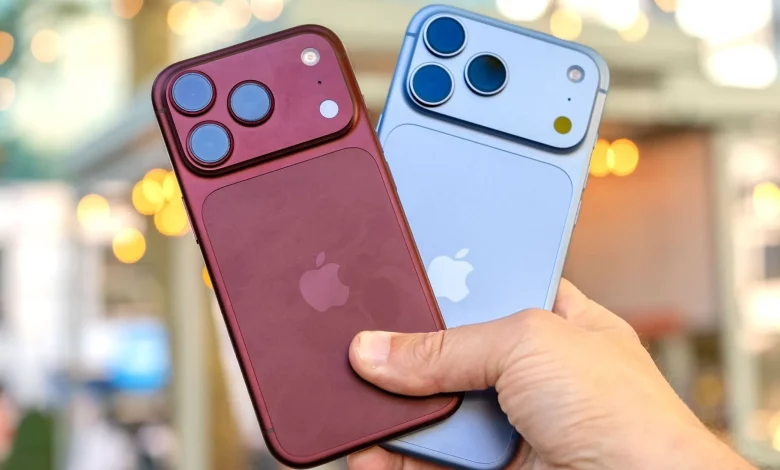
Tom’s Guide has published an in-depth review of the iPhone 18 Pro and iPhone 18 Pro Max, which Apple is pitching as its most powerful phones yet. The models feature the new A20 Pro processor, a camera with a variable aperture, noticeably better battery life and the fastest iPhone charging so far. At the same time, both handsets are $100 more expensive than the previous generation and heavier than their predecessors.
According to the review, in the US the iPhone 18 Pro starts at $1,199 for the 256GB version, in the UK — from £1,199, and in Australia — from AU$2,099. The iPhone 18 Pro Max starts at $1,299 / £1,299 / AU$2,299 for the same storage capacity. Both phones are available with 256GB, 512GB, 1TB and 2TB of storage. The colour options are Black, Silver, Glacier and Burgundy.
The headline feature of the line-up is the A20 Pro chip, the first 2nm processor in an iPhone. It has two high-performance CPU cores (up to 20% faster), four efficiency cores, a 7-core GPU (up to 40% faster than the previous generation) and a new doubled 16-core Neural Engine for artificial intelligence tasks. The review also highlights the redesigned cooling system: the memory is positioned next to the SoC, and the vapour chamber is three times larger, which improves heat dissipation.
In the Geekbench 6 benchmark, the iPhone 18 Pro and 18 Pro Max scored around 4,700 points in single-core mode, roughly 25% higher than the iPhone 17 Pro and Galaxy S26 Ultra with the Snapdragon 8 Elite Gen 5 for Galaxy. In multi-core mode, the advantage over the 17 Pro reaches 28%, and over the Galaxy S26 Ultra — about 10%. In the 3DMark Solar Bay Unlimited test, the iPhone 18 Pro delivered 61.93 fps, and the 18 Pro Max — 67.9 fps, which is 33–45% faster than the previous generation. Performance stability in the 3DMark Wild Life Extreme Stress Test for the iPhone 18 Pro Max reached 79.4%, significantly better than the iPhone 17 Pro Max and Galaxy S26 Ultra.
The Neural Engine’s potential has also grown significantly: in the Geekbench AI test, the iPhone 18 Pro scored 69,245 points, and the iPhone 18 Pro Max — 71,974, which, according to Tom’s Guide, translates to a 41–48% speed-up for on-device AI tasks. This should have a positive impact on the new Siri AI and Apple Intelligence features.
Thanks to the more efficient A20 Pro and larger batteries, Apple is claiming record-breaking battery life for the brand with the iPhone 18 Pro Max. In Tom’s Guide’s in-house test, which involves continuous 5G web surfing at 150 nits brightness, the iPhone 18 Pro Max lasted an average of 18 hours 27 minutes (with a maximum result of 18:41), whereas the iPhone 17 Pro Max managed 17:54. The iPhone 18 Pro achieved an average of 16:17 versus 15:21 for the iPhone 17 Pro. For comparison, the Galaxy S26 Ultra in standard display mode lasted 16:40, while the OnePlus 15 with its silicon-carbon battery remains the leader at 25:13.
Both models support 60W wired charging and up to 35W wireless charging. Apple promises up to 30% charge in 15 minutes, but in testing the iPhone 18 Pro reached 53% in 15 minutes and 80% in half an hour. The iPhone 18 Pro Max hit 44% in 15 minutes and 77% in 30 minutes, so it charges slightly more slowly than the smaller model.
The cameras on the iPhone 18 Pro and Pro Max have gained their key innovation — a variable-aperture main module. The primary 48-megapixel camera can switch between f/1.48, f/1.8, f/2.8 and f/4 thanks to six moving blades inside the lens. The system can automatically open the aperture up to f/1.48 for portraits and low-light shooting, or stop down to f/4 when greater depth of field is required. Users also get new Pro controls that allow them to select any of the four aperture options manually.
In practical examples, Tom’s Guide shows how the variable aperture lets you either blur the background at f/1.48 or keep it sharper at f/4 in shots such as portraits or flower photos. The wider maximum aperture also lets in more light, which noticeably improves night shots: in an almost pitch-dark frame with a US flag, details of the pole and brickwork are more visible in the iPhone 18 Pro photo, while the Galaxy S26 Ultra lags behind in clarity.
The camera array consists of a 48MP main module with variable aperture, a 48MP ultra-wide lens (f/2.2) and a 48MP telephoto with 4x optical zoom. Overall, Apple delivers up to 8x “optical-quality” zoom. At 10x zoom, iPhone shots are competitive with the Galaxy S26 Ultra, but at 40x, the reviewer says the Samsung phone delivers a crisper result. The front camera on both iPhones has an 18MP resolution and an f/1.9 aperture.
For video, there is now the option to add Cinematic mode after you’ve already shot your clip — you no longer have to select this mode before you start recording. Apple has also added 4K Timelapse in Dolby Vision HDR, improved 1080p low-light video quality and introduced Pro controls for video (such as shutter speed adjustment). Compared with the Galaxy S26 Ultra when shooting in 4K/30 HDR, the iPhone 18 Pro, according to Tom’s Guide, shows better detail in rocks and smoother zooming, although the Galaxy pulls ahead at extreme close-ups thanks to its more powerful zoom.
The review pays special attention to Siri AI and Apple Intelligence working together with iOS 27. Siri now takes user context into account more effectively and can perform several actions from a single voice request, for example, finding hotel reviews and immediately sending them in a message. You can also control several apps at once — set a reminder, start a timer and find a photo to add to a note. At the same time, it’s noted that in some cases the assistant starts executing the first task before the user has finished voicing the second.
The Visual Intelligence feature can recognise information in the frame — for example, dates on a poster — and suggest adding them to your calendar. The camera app has gained a dedicated Siri mode. Apple Intelligence also offers new photo-editing capabilities, including Reframe (changing the framing with generated background), background expansion and an improved Clean Up tool for removing unwanted objects. The reviewer notes that these tools can be impressive, but sometimes produce slightly “odd” results.
In terms of design, the iPhone 18 Pro and Pro Max look very similar to the iPhone 17 Pro, but they have a new colour palette and a better match between the frame and the matte glass, so the two-tone effect is gone. One visual change is the smaller Dynamic Island: Apple has moved the Face ID infrared sensor under the display, making the cut-out more compact. Dynamic Island can now display up to three live activities simultaneously, such as a timer, Spotify and Uber status.
The dimensions of the bodies remain the same as the 17 Pro series, but the weight has increased. The iPhone 18 Pro weighs 211g (versus 206g for the iPhone 17 Pro), and the 18 Pro Max — 249g (versus 233g for the 17 Pro Max). This is likely due to the larger batteries, the more complex variable-aperture camera and the enlarged vapour chamber. One benefit for users is that the new models are compatible with cases from previous Pro phones.
The screens are still 6.3 inches on the iPhone 18 Pro and 6.9 inches on the 18 Pro Max. Both displays are Super Retina XDR with a 120Hz refresh rate and a claimed peak brightness of 3,000 nits. In Tom’s Guide’s lab measurements, the iPhone 18 Pro Max reached a maximum brightness of 2,326 nits in a 25% window and 1,762 nits in a 10% window; the iPhone 18 Pro managed 2,314 and 1,627 nits respectively. These figures are close to the iPhone 17 Pro Max, while the Galaxy S26 Ultra produced around 1,478 nits in the HDR test. Owners of older models (such as the iPhone 16 Pro) will also appreciate the anti-reflective coating.
In conclusion, Tom’s Guide finds that the iPhone 18 Pro and iPhone 18 Pro Max are exceptionally powerful smartphones that make a clear step forward in performance, camera quality and battery life, but without a radical redesign. On the downside, the review notes the higher price and increased weight, as well as the fact that Android rivals, particularly the Galaxy S26 Ultra, still have the edge for zoom capabilities and some AI features. Even so, the reviewer calls Apple’s new Pro models “the best non-foldable phones you can buy right now”.