

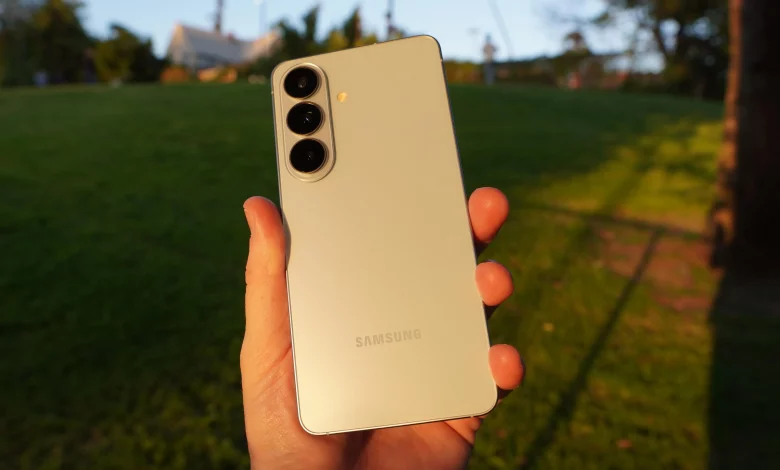
The Samsung Galaxy S26 has become the company’s latest standard flagship, with a clear emphasis on software capabilities and artificial intelligence, but it has also gone up in price. The smartphone costs 900 US dollars for the version with 256 GB of storage, which is 100 dollars more than last year’s Galaxy S25 that started at 800 dollars.
Externally, the Galaxy S26 has barely changed: it is a smartphone with flat edges, a glass back panel and dust- and water-resistance to the IP68 standard. The screen diagonal has increased to 6.3 inches thanks to thinner bezels. The AMOLED display with a resolution of 2,340×1,080 pixels supports HDR10+ and has a peak brightness of up to 2,600 nits, ensuring good legibility in sunlight. The model is available in cobalt violet, white, sky blue and black.
The main camera module has not received any hardware changes compared with the Galaxy S25: the smartphone is equipped with a 50-megapixel wide-angle camera, a 13-megapixel ultra-wide and a 10-megapixel telephoto lens with 3x optical zoom. All improvements have been made at software level. One standout feature is Horizontal Lock, which significantly stabilises video even with strong hand shake or when the phone’s position changes. To activate it, you need to open the additional menu in video mode and switch the option on manually; once you exit video mode, you will have to turn it on again.
The smartphone delivers consistently good image quality in various conditions: landscapes, city architecture, food and selfies look detailed and contrasty. The telephoto camera allows you to capture usable shots with 3x optical and up to 30x digital zoom. At the same time, it can sometimes struggle to convey subtle changes in lighting in overcast skies or in scenes with challenging contrast.
A separate section for AI photo editing has appeared in the gallery. The user can take advantage of AI eraser tools to remove objects, Move to reposition them, Style to stylise shots (for example, as a comic or anime), as well as text prompts to the AI to change the background or add new elements. All these changes are applied after shooting, and edited images receive a digital watermark indicating the use of AI. The tools require an internet connection to work.
Performance in the Galaxy S26 is handled by the Qualcomm Snapdragon 8 Elite Gen 5 for Galaxy processor paired with 12 GB of RAM. In synthetic benchmarks, the smartphone shows higher results than the Galaxy S25 with the previous chip and comes close to top-end models such as the iPhone 17 Pro Max and RedMagic 11 Pro. In everyday use, the device runs quickly, with no noticeable interface slowdowns, and confidently copes with demanding games.
The base version of the Galaxy S26 now has 256 GB of built-in storage, and there is also a 512 GB configuration available for 1,100 dollars. There is no support for memory cards. The battery has been increased to 4,300 mAh from 4,000 mAh in its predecessor, which is usually enough for roughly one day of use. However, charging speed remains a weak point: 25 W wired charging delivers around 55% in half an hour, with a full cycle taking over an hour. The 15 W wireless charging restores around 22% in 30 minutes. Against this backdrop, competitors at a similar or lower price offer significantly faster charging.
The smartphone supports reverse wireless charging for headphones or a Galaxy Watch, but it does not have built-in magnets for accessories like the iPhone 17 or Google Pixel 10. For similar functionality, Samsung offers separate cases with a magnetic ring.
The Galaxy S26 ships with Android 16 and the One UI 8.5 skin. The manufacturer promises seven years of Android updates and security patches. The new version of the interface brings more Galaxy AI features that are meant to adapt to the user’s habits. The updated Circle to Search feature from Google allows you to highlight objects on the screen for search, including clothing items.
A separate block of AI features relates to multimedia and calls. Audio Eraser attempts to remove background noise in video from streaming services and social networks, while Document Scanner automatically straightens documents and removes shadows. Call Screening allows Galaxy AI to answer a call first and find out who is calling, and Scam Detection warns you if the system detects signs of fraud in the conversation. Creative Studio is also available for creating stickers and invitations, and Now Nudge is designed to suggest relevant data and files depending on the context of use, although this feature requires a longer period of use for a full assessment.
Against the backdrop of the Galaxy S26 Plus and Galaxy S26 Ultra, the base model looks more balanced in terms of features and price, although it lags behind them in charging speed, screen size and the range of additional functions. Compared with the Galaxy S25, the main differences are the new processor, increased storage in the entry-level configuration, a slightly larger display, a bigger battery and an expanded set of AI tools, while the cameras and charging speed remain at the same level.
Given the rise in smartphone prices in 2026, the Galaxy S26 is unlikely to be an exception on the market. At the same time, numerous promotions and trade-in programmes from Samsung and mobile operators can partially offset the price increase. For those looking to save money, the Galaxy S25 remains an option, as it is still on sale, although the price difference between the 256 GB versions of the two models is currently not that significant.
In summary, the Galaxy S26 is a powerful flagship with a modern design, a high-quality display, strong cameras and a wide range of AI features, but without a breakthrough in hardware. The main compromises concern charging speed and battery capacity, as well as the higher price, but with discounts and attractive offers the smartphone could become an appealing upgrade option in 2026.