

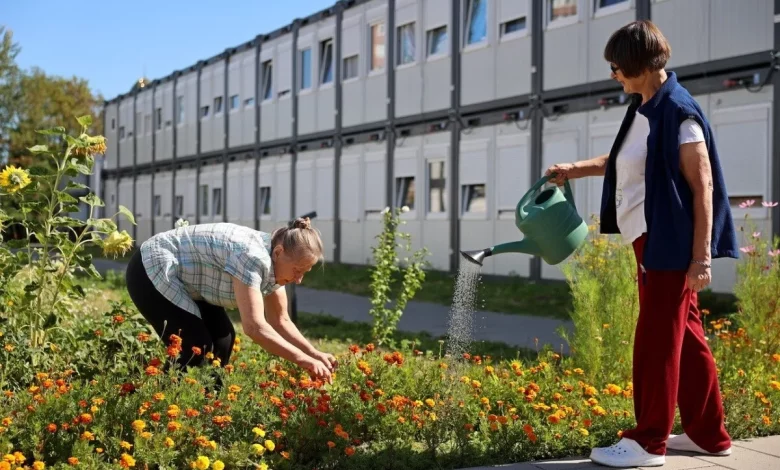
In the modular settlement “Mariapolis” in Sykhiv in Lviv, forcibly displaced Ukrainians have been planting flowers and setting up small vegetable plots next to their temporary homes for the third year in a row. This is how people who have had to leave their homes because of the war create a space around them that reminds them of home: here grow marigolds, asters, dahlias, sunflowers, as well as cucumbers, courgettes, potatoes, tomatoes, peppers and even watermelons.
The first flowerbeds appeared in 2023 with the support of the Social Support Centre. Since then, a few flower beds have turned into dozens of well-tended plots and green corners. Residents are already harvesting, making homemade preserves and sharing herbs with one another. For many, this is not only a way to have their own vegetables, but also a chance to restore familiar daily rituals and feel cosy in spite of living in temporary accommodation.
One of the first to start greening the grounds was Ms Tetiana from the village of New York in Donetsk region. She has been living in “Mariapolis” for three years, and has been caring for flowers since childhood. In 2023, together with her daughter, she planted the first flowerbed next to her little house with marigolds, petunias and gerberas. Now, zinnias, asters, chrysanthemums and dahlias bloom here every year, and next to them neighbours have laid out vegetable beds.
“We were the first in the settlement to plant flowers. At first people laughed at me and asked why I needed this. And I said: these flowers are my home. My home is here now and I want it to be cosy and beautiful around it,” recalls Ms Tetiana.
She says she inherited her love of flowers from her grandmother, whose yard was in bloom from early spring to late autumn. Now her daughter continues this tradition, and her granddaughter comes to admire the flowerbed in “Mariapolis”. Ms Tetiana’s flowerbeds attract not only residents of the settlement: people from nearby blocks of flats also drop in to photograph the flowers, as the area is open.
Gradually, others joined the initiative. Today, dozens of different plants grow on the territory of the modular settlement, and the first cucumbers, courgettes, potatoes, herbs, tomatoes and peppers are ripening on several vegetable plots. Resident Volodymyr Chuiko from Kharkiv region planted watermelons for the first time this year and admits he did not expect them to take, but he already has several small fruits.
Before the full-scale invasion, Volodymyr worked in agriculture. He is now unable to work, as he cares for his wife, who has a disability. He says that his patch has become a way for him to stay active and continue doing what he is used to, despite the new circumstances.
Seventy-two-year-old Volodymyr Kuznetsov from Sloviansk has also created his own “allotment under the windows”. In the past, he worked as an electrical engineer at a nuclear power plant and did not do any gardening. In “Mariapolis” he has planted a small vegetable garden: a few pepper bushes, tomatoes, cucumbers and sunflowers, and he also brought small fir trees from the Carpathians and planted them next to his house. He says he wants to see the same cosiness around him as in a traditional Ukrainian village.
For Olena Dmytriieva from Lysychansk, the beds in the modular settlement have also become part of her familiar way of life. Back in her home town, her family cultivated about 40 ares of land and grew almost everything they needed, and kept livestock. Now the plot is much smaller, but the family again eats mainly what they grow themselves: they have their own cucumbers for salads and pickling, herbs, potatoes and peppers. Olena gives part of the harvest, including sorrel, to her neighbours, happily noting that everyone can cook themselves a pot of sorrel borshch.
Olena admits that working the soil helps distract her from heavy thoughts about the war and at the same time restores a sense of normal everyday life, familiar from peacetime.
In total, about a thousand forcibly displaced Ukrainians now live in “Mariapolis”. Most already work in Lviv and are gradually setting up their new daily lives. For older people, the opportunity to have a small vegetable plot or flowerbed has become an important source of support – a familiar kind of work that gives them strength and boosts their confidence.
The administrator of the modular settlement, Artem Sobolenko, says that the initiative of residents to greet spring with spades and seedlings came from them. When people approached the administration to ask for permission to plant flowers and vegetables next to their houses, it agreed and helped with organising the plots. What began with a few flowerbeds has grown into full-fledged green zones that residents look after every day.
The city, for its part, supports the initiative: it provides gardening tools and some of the seedlings so that people can improve the space around their temporary homes. The green oasis created by displaced people has become part of the urban landscape, visible to residents of the surrounding Lviv apartment blocks.
The director of the Social Support Centre, Volodymyr Holovatyi, stresses that for people whom the war has forced to leave their homes, it is important not only to have a roof over their heads, but also to create an environment that reminds them of their home town and restores a sense of home. He says that residents often ask when they will be able to return, but because the war is ongoing, no one can give a definite answer.
According to the head of the centre, for someone who has lost their home, planting marigolds next to a new little house, watering the cucumbers or picking the first courgette is a way of telling themselves that life goes on, and that even in temporary shelter it is possible to create a place where you want to wake up, work, socialise and wait for victory.
“Mariapolis” is the largest modular settlement in Lviv for forcibly displaced people. It opened in Sykhiv in May 2022. The settlement was named in honour of the Holy Virgin Mary and the city of Mariupol, destroyed by Russian aggression, as its first residents were people who had fled Mariupol. Today Ukrainians from different regions live here, and working the land together helps them support one another and build a new everyday life.