

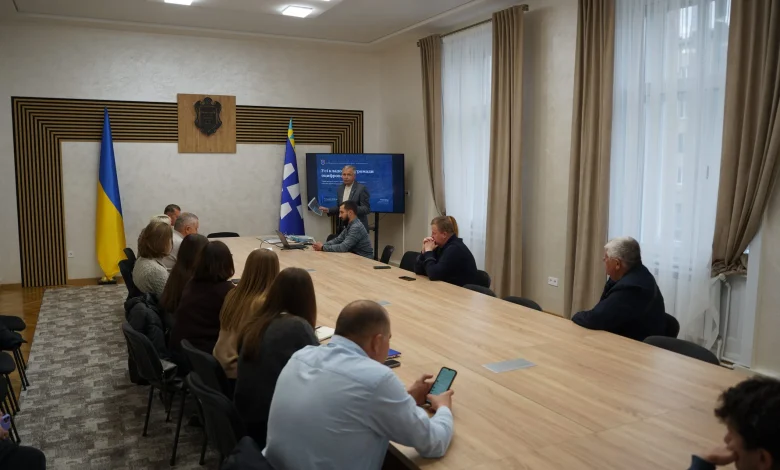
The Drohobych community has presented the results of a large-scale project to digitise burial sites. A comprehensive digital map has been created for all 55 cemeteries managed by the municipal enterprise “SMU”, making this the first project of its kind on such a scale in Ukraine.
The presentation took place at Drohobych City Council with the participation of local and regional media. The results were presented by the deputy director of the municipal enterprise “SMU” Andrii Yaniv and the developer of the service memoriamap.com.ua, Stebnyk resident and veteran of the Russian-Ukrainian war Oleh Lekhush.
According to Andrii Yaniv, the cemeteries were put in order in a comprehensive way. The work covers four key areas: preparation of technical documentation for the cemeteries, digitisation of burial data, improvement of the grounds, and development of designs for columbaria for the burial of urns with ashes. A total of 92 families have already used cremation services, so the community is preparing for growing demand for this type of burial place.
The digitisation itself was carried out by Oleh Lekhush. He stressed that previously burial records were kept mainly in paper ledgers, and there was no unified system. Now all the data have been brought together in a single electronic database, which makes it possible to systematise the information and preserve it for future generations.
Within the project, data from 55 cemeteries with a total area of 109 hectares were processed, which roughly corresponds to 150 football pitches. The digital register contains information on 69,002 graves and 80,778 individuals. To achieve this, more than 70,000 photographs were taken and each cemetery was surveyed from the air using a drone.
Each cemetery is now shown on a digital map with clearly defined boundaries and sections. This greatly simplifies the search for burial sites and organises information that was previously scattered across various paper documents. One of the biggest challenges was damaged or worn inscriptions on headstones. In such cases, the data were restored with the help of local residents, who assisted in identifying the burials.
The collected body of information also made it possible to carry out a historical and demographic analysis. The earliest legible entry in the database dates back to 1792. According to the statistics, around 1,600 burials are carried out in the community’s cemeteries every year. Life expectancy in different localities was also analysed: the highest average figure — about 75 years — was recorded in the villages of Selets, Bystrytsia and Volia Yakubova, while the community-wide average is 66 years.
Researchers also looked separately at the most common male and female first names, as well as the indigenous surnames of residents of the community’s settlements. According to the developer’s estimate, the accuracy of the digital database created is around 98%, and work to improve it will continue.
Next steps include integrating a burial search function into the official website of Drohobych City Council, installing information boards in cemeteries and creating a CRM system to keep records of available plots.
The Mayor of Drohobych Taras Kuchma emphasised the importance of the project for the community and the role of young specialists in its implementation during the presentation.
This is a titanic effort. I can already see how our cemeteries are changing. We must ensure that the burial places of our loved ones are not bleak or neglected, but become places of remembrance and respect. Because a cemetery is not just a burial ground. It is our memory
The Drohobych community stresses that creating a digital map of cemeteries is not only a modern tool for record-keeping and management, but also a way to preserve the names, stories and memory of the people who shaped the community’s history.