

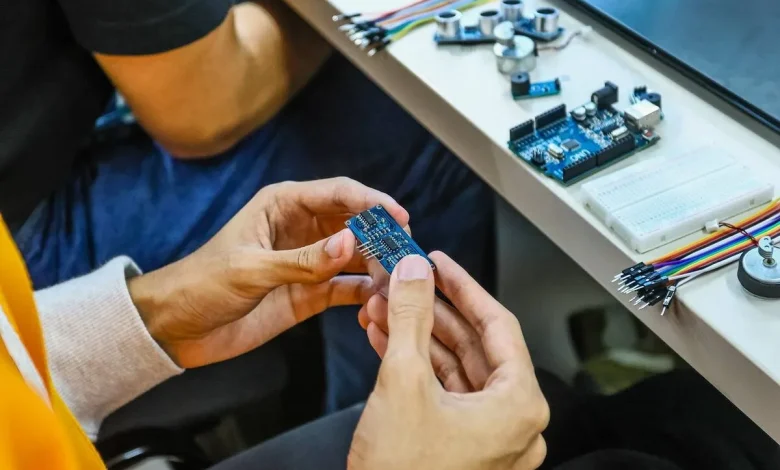
On 24–25 October, Lviv hosted the first Inclusive Technology Hackathon, during which students together with veterans and patients of the National Rehabilitation Centre UNBROKEN developed technological solutions for people living with the consequences of war-related injuries. The work involved 24 students from leading Kyiv universities, veterans, patients of the centre, doctors, occupational therapists and technical mentors.
The event was organised by UNBROKEN, the Techiia Foundation and the Ukrainian technology company Esper LLC. Participants were divided into four teams which, over two days, developed prototypes of devices and services for people with visual impairments and upper limb amputations, in order to make their everyday lives more independent.
The first team presented the platform “Poruch” (“Nearby”) — a digital service to support people with amputations. The platform offers personalised recommendations depending on the level of amputation and the user’s needs, includes a library of practical tips, step-by-step and video instructions, as well as a catalogue of adaptive clothing, specialised products and assistive accessories. Users will be able both to find ready-made solutions for everyday tasks and to share their own experience.
The second team, which included students from the Kyiv School of Economics, developed the immerSEE system — an intelligent solution for people with visual impairments. It is designed to help them move around more safely, detect obstacles and navigate their surroundings more effectively thanks to sensor technologies and artificial intelligence capabilities.
The third team presented the Adeck (Adaptive Deck) device — an adaptive panel with physical buttons for using a smartphone by people with visual impairments and upper limb amputations. In future, the developers plan to add modules for people with hearing impairments and to integrate the device with smart home systems so that it can be used to control household appliances. According to preliminary estimates, the approximate production cost of one device will be around 50 dollars, and implementing the project will take roughly six months.
The fourth team created the Plat. On solution — a technology for operating a smartphone without using one’s hands. It is aimed at people with upper limb amputations, limited arm mobility, as well as partial or complete loss of vision. The prototype combines an Android app with an external control device and already includes eight basic functions: making calls, checking the phone’s battery level, viewing the time, controlling the torch, checking the account balance, receiving descriptions of photos and screenshots, and configuring the app. The functionality is planned to be expanded further.
On 25 October, the teams presented their developments. The next step is to assess the potential for practical application of the prototypes and further refine them. The Techiia Foundation will review the proposed solutions for potential implementation and funding of the first limited batches of devices so that they can be used by patients in real life.
For the UNBROKEN centre, the hackathon was an opportunity to combine medical expertise with the work of young engineers. UNBROKEN CEO and Director of Communications of the First Medical Association of Lviv Iryna Zaslavets stressed that all the tasks for participants were based on the real needs of patients, and that a key element was the direct involvement of veterans working alongside students.
The Techiia Foundation, which supports social initiatives in Ukraine, including prosthetics for service personnel and providing hospitals with equipment, acted as a partner of the hackathon, with a focus on the practical implementation of inclusive technologies. The Chair of the Foundation’s Board, Yuna Chase, emphasised that charitable work should not only respond to the consequences of war, but also create solutions that will be useful in the future, bringing together the needs of people with injuries and the potential of Ukrainian developers.
The event’s technology partner was the Ukrainian company Esper LLC, which develops Esper Hand bionic prosthetic arms. Company representatives shared their experience of designing products focused on users’ needs. Esper LLC’s Creative Director Dmytro Hanush noted that veterans’ participation in the teams’ work gave students the opportunity to receive direct feedback and adapt their solutions to real-life situations.