

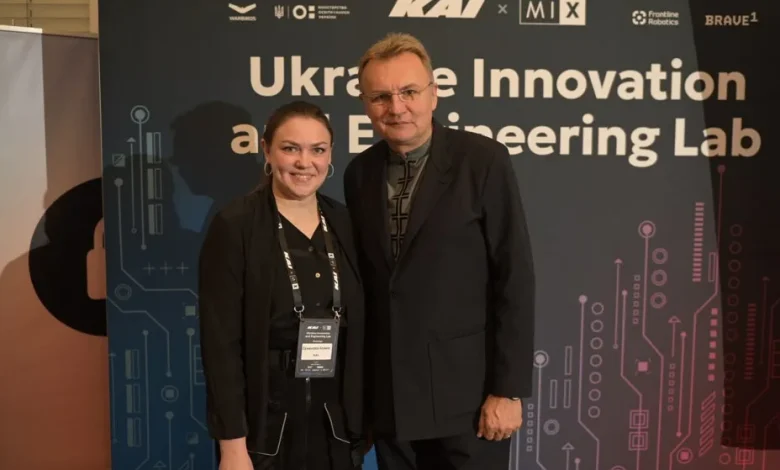
An international engineering programme, the Ukraine Innovation and Engineering Lab, has started operating in Lviv. It has been created by the National University “Kyiv Aviation Institute” (KAI) together with the Massachusetts Institute of Technology (MIT). It is based on a real MIT course and is aimed at students, engineers, graduates of technical disciplines and veterans who want to work on real technological challenges coming from Ukrainian businesses.
After the initiative was launched in Kyiv, where the programme was presented by the course author Gene R. Keselman, Senior Lecturer at the MIT Sloan School of Management and a US Air Force veteran, a separate track in Lviv was opened due to the large number of applications from the western regions. At the presentation in the city, the participants were welcomed by Mayor Andriy Sadovyi, who wished them ideas capable of strengthening Ukraine.
The President of KAI, Ksenia Semenova, noted that at first the programme was planned to run only in the capital, but due to the level of interest from applicants from the west of the country it was decided to organise an additional cohort in Lviv. In total, around 200 people registered for the course, of whom 100 participants were selected — students, graduates of technical disciplines and veterans. Over 10 weeks they will work in teams on cases proposed by companies, and will present the results at a joint Demo Day.
The Director of the Ukraine Innovation and Engineering Lab programme and KAI Vice-Rector for Admissions and Online Education, Radmila Segol, explained that the Ukrainian programme is based on an MIT course in which teams from MIT and Harvard spend a semester solving tasks set by special operations forces, completing their studies by creating prototypes that can be acquired by companies. She personally completed this course and initiated its adaptation for Ukraine with the support of Gene Keselman. Ukraine has become the first country where the programme has been launched outside MIT.
Teaching on the Lviv track will take place offline, as the work requires constant team interaction and access to laboratories. Participants will be divided into 10 teams which, over the course of 10 weeks, will develop working prototype solutions for Ukrainian companies. The programme is open to people aged 18 and over with an engineering education or work experience in the relevant field.
The role of business in the initiative was outlined by the Director of NDA Recruitment, Zlata Dodatko. Companies draw up real cases which are put forward for development within the framework of the programme, and participants are free to choose which tasks they will work on when creating prototypes.
Companies provide the cases, and we present them publicly within this programme. With the help of our partners, who communicate with students, we have put together tasks for the development of specific prototypes. These are problems for which students must find solutions. It is important for us that the engineering market develops and that we can place students with our partners for internships and grant programmes
According to Zlata Dodatko, this kind of cooperation helps companies to see potential employees at work on real projects, while participants gain practical skills, real cases for their portfolios and better opportunities for professional growth. She stressed that Ukrainian engineering is currently showing rapid growth worldwide, so education must keep pace with these challenges.
The programme in Lviv will run from November 2026 to February 2027. It is being implemented by KAI and MIT together with the company Skyfall, with the support of the Ministry of Education and Science of Ukraine and the Lviv City Council, and in partnership with the Ukrainian companies NDA Recruitment, Sine Engineering, Warbirds and Frontline Robotics.
The Ukraine Innovation and Engineering Lab is a 10-week, project-oriented engineering programme whose aim is to bring together strong technical participants, academic expertise, university infrastructure and real business needs in order to create ready-to-use technological prototypes.