

In the village of Iliv in Stryi district, Lviv region, archaeological research is under way at the site “Iliv Hillfort-Sanctuary”. An expedition has been working here since 2023 and this summer fully uncovered the feature known as the “kapyshche” (pagan shrine).
The excavations are being carried out by a joint expedition of the municipal institution of the Lviv Regional Council “Administration of the Historical and Cultural Reserve ‘Stilske Hillfort’” and the I. Krypiakevych Institute of Ukrainian Studies of the National Academy of Sciences of Ukraine, led by Candidate of Historical Sciences Andrii Havinskyi. Volunteers, students and local historians are also taking part in the work.
This August, archaeologists continued to investigate the mound on the inner side of the rampart of the citadel, which had been partially studied back in 1987 and at that time was interpreted as a pagan sanctuary. Beneath the mound, about one metre high, they discovered a stone U-shaped structure approximately 7 metres long and 3.5–4 metres wide. It adjoins the base of the rampart, where remains of heavily burnt logs and planks were recorded.
In the fill of the structure and in the mound, isolated archaeological materials from the Eneolithic period and the princely era were found. This provides grounds to associate the feature with the long-term use of the hillfort area in different historical periods.
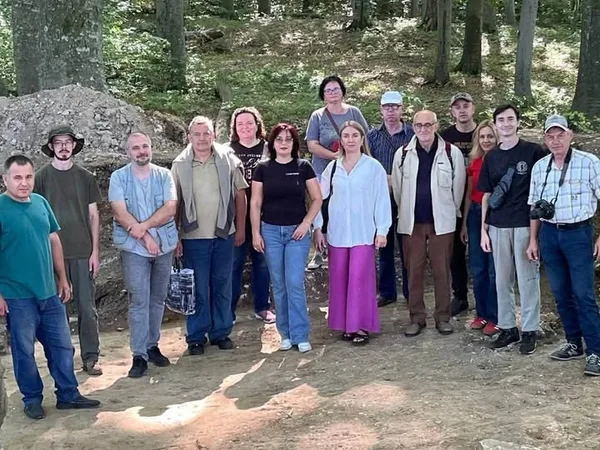
On 28 August, a field seminar was held at the Iliv hillfort with the participation of archaeologists, scholars, museum workers and specialists in the field of cultural heritage protection. During the meeting, they discussed the results of the latest excavations and various interpretations of the structure discovered. Participants considered the most convincing hypothesis to be that a wooden tower stood on the stone foundation in the Middle Ages.
The results of many years of research at the Iliv hillfort are to be summarised and published in a collective monograph. Further directions for the study of this site and other features of the Stilske Hillfort Historical and Cultural Reserve, of which it forms part, have also been outlined.