

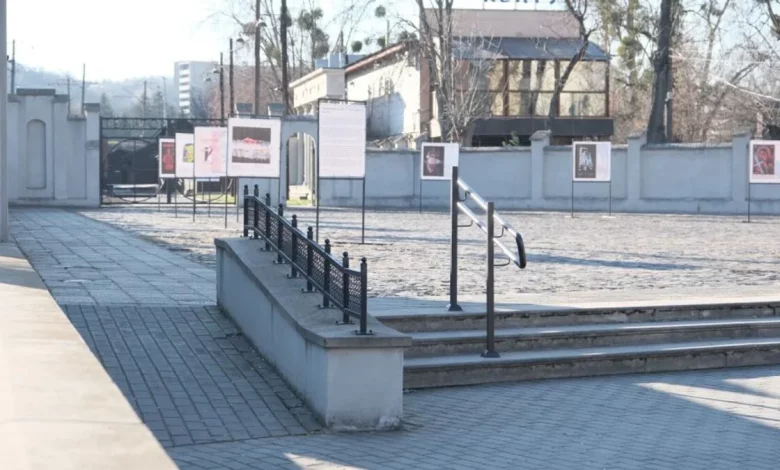
A decision has been taken in Lviv to rename the Memorial Museum of Totalitarian Regimes “Territory of Terror” and to expand its activities. Once all legal procedures have been completed, the institution will officially operate under the name “Museum of the History of Wars, Struggle and Resistance”.
The Lviv City Council stresses that this is not about abandoning the themes already developed or the museum’s key memorial space. The new name is intended to reflect more accurately the range of subjects the institution now works with, and to create opportunities for further development.
Over the course of its work, the museum has significantly broadened its areas of research, collections, exhibitions and educational projects. In addition to the history of the Lviv Ghetto, Transit Prison No.25 and the crimes of the Nazi and Soviet totalitarian regimes, it now examines deportations and political repressions, the legacy of the Sixtiers and the dissident movement, the history of the struggle for rights and freedoms, the process of Ukraine gaining independence, and the theme of lost childhood during war. The museum also documents the current Russian-Ukrainian war and builds relevant collections.
It is precisely this expansion of thematic areas that prompted the decision to adopt a more generalising name that brings together different, but interconnected, narratives about the experience of war, resistance and the preservation of memory.
The museum’s director, Olha Honchar, explained that the new name encompasses three semantic dimensions: “wars” as a continuation of work on the history of Soviet totalitarianism, occupations and the current Russian-Ukrainian war; “struggle” as a summation of the experience of the Sixtiers, the dissident movement and various forms of civil and armed resistance; and “resistance” as a broader concept that covers not only political or military opposition, but also the preservation of identity, culture, memory and human dignity.
“It is important to us that this name does not erase the museum’s previous experience, but on the contrary grows out of it and allows us to speak about the past and the present within a single, broader context” — Olha Honchar
At the same time, “Territory of Terror” as a specific memorial space will remain an important part of the institution. The exhibition dedicated to the Lviv Ghetto, Transit Prison No.25 and the crimes of totalitarian regimes will continue to operate here. The museum emphasises that its current stage of development also requires addressing how the traumatic experience of the 20th century echoes in today’s war, how society resists violence and preserves memory.
The municipal Department of Culture notes that the renaming is part of a broader strategy for the institution’s development. The museum is seen as a space that brings together the experiences of totalitarian regimes, the struggle for freedom in the 20th century and the current context of full-scale war, while also providing an opportunity to reflect on the present, to document it and to foster dialogue with visitors.
Recently, the museum grounds hosted a music-and-history event entitled “This is how Independence sounds”. In different parts of the complex, visitors heard works by composers whose lives and creative paths were broken by totalitarian regimes, wars, repressions, deportations, censorship and emigration.
The Memorial Museum of Totalitarian Regimes “Territory of Terror” was established on land linked to the history of the Lviv Ghetto and Transit Prison No.25. Initially, its work focused on researching and comprehending the crimes of the Nazi and Soviet totalitarian regimes. Over time, the institution broadened its scope: today it studies the history of totalitarianism, deportations, imprisonment and political repressions, the dissident and human rights movement, the struggle for Ukraine’s independence, documents the current Russian-Ukrainian war, builds new collections and implements exhibition and educational programmes.
Once the changes have been registered by the state, the museum will officially operate under the name “Museum of the History of Wars, Struggle and Resistance”.