

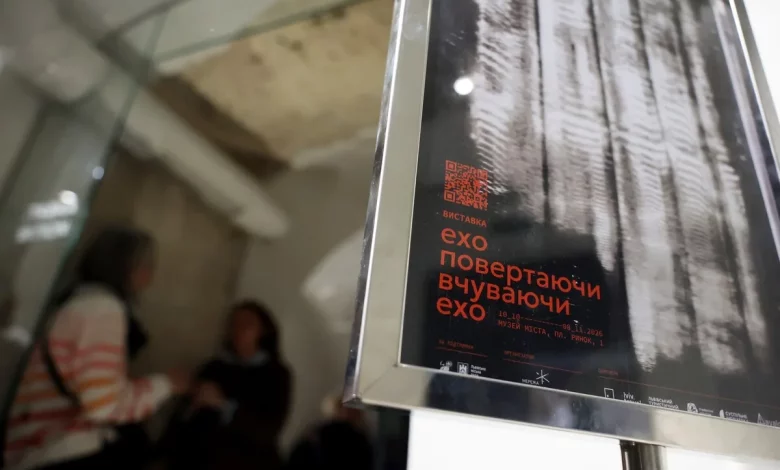
A new exhibition, “Echo Returning, Hearing Echo”, has opened at the Museum of the City in Lviv. Through sound and visual installations, it connects Ukrainian musical heritage of the 19th–20th centuries with the work of contemporary artists, including those currently serving in the armed forces. The exhibition runs from 10 October to 8 November.
The central idea of the project is to show the resonance of Ukrainian culture which, despite censorship and attempts at destruction, continues to live on and influence new generations of authors. Lviv Mayor Andriy Sadovyi attended the opening of the exhibition.
The exhibition’s co-author, director of LKP “Lviv Radio” Andriy Linik, explained that the display is built around the theme of echo from Ukrainian composers and artists who created culture in the 19th and early 20th centuries. Visitors are greeted by the sound installation “Resonances” by Lviv composers Anton Malynovsky, who is currently serving in the AFU, and Ostap Manulyak. It reinterprets early recordings of Ukrainian music, in particular the works of Vasyl Barvinsky and kobzar melodies recorded by ethnographer Filaret Kolessa.
To create this work, they used sounds from digitised wax cylinders on which kobzar songs were once recorded. The contemporary interpretation turns the old recordings into a kind of dialogue between artists of the past and today’s creators of Ukrainian culture.
A separate part of the exhibition is devoted to the dramatic history of preserving the musical heritage of composer Vasyl Barvinsky. During the Soviet period, orders were issued to destroy his recordings first in Kyiv, and then in Lviv. An employee of the Lviv radio company, Marta Kinasevych, secretly saved the original tapes by erasing others instead. Some of Barvinsky’s surviving works have also been included in the sound interpretation “Resonances”.
The exhibition also presents copies of archival documents, including Marta Kinasevych’s written explanation of why she broadcast Barvinsky’s music. According to Andriy Linik, the exhibition shows not only the work of composers, but also the history of the struggle to preserve Ukrainian cultural heritage in times of censorship.
Lviv Mayor Andriy Sadovyi, speaking at the opening, underlined the importance of culture in wartime.
“In my view, creativity during war gives an important emotion that activates the brain. Then a person finds solutions and options for action. After all, to survive, we need these impulses. And culture and art are what encourage this best of all,” said Andriy Sadovyi.
Another important part of the exhibition is an installation by artist Kosti Vidmotai, created from two Soviet-era shelving units and boxes of tapes from Lviv Radio. As Andriy Linik explains, it serves as a reminder of the Soviet system of control over musical culture, when the authorities decided which works to preserve and which to destroy, what could be publicly played and what had to remain under censorship.
Visitors can listen to the sound compositions included in the exhibition as they move through the display. The project has been implemented in cooperation with the Museum of the City, the tourism office and the Department of Culture of the Lviv City Council, with the participation of Avalon. Materials from the archive of JSC “NSTU” were used for the exhibition.
Admission to the exhibition is free of charge, but advance registration is required at the tourist information centres or at the Museum of the City’s reception.
Tourist information centres:
- 1 Rynok Square — daily from 09:00 to 20:00;
- 1 Dvirtseva Square — daily from 09:00 to 18:00;
- 6 Pidvalna Street — daily from 10:00 to 18:00.
Exhibition opening hours:
- Monday–Friday: 12:00–20:00;
- Saturday–Sunday: 10:00–20:00.