

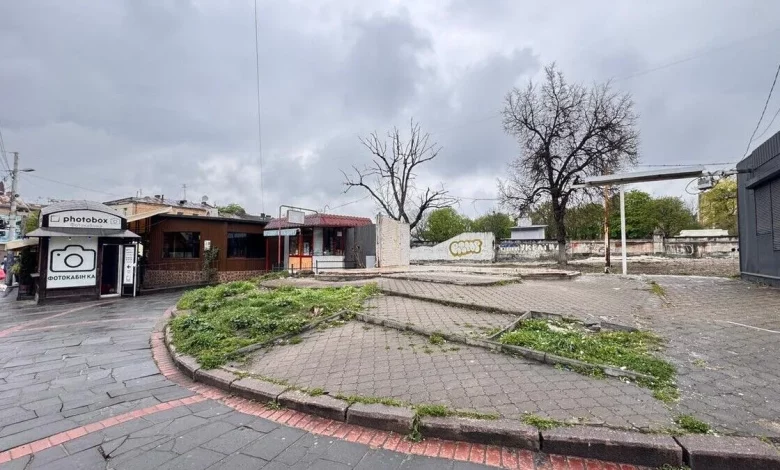
The Lviv City Council is continuing legal proceedings to return to the city the plot of land of the former Dobrobut market near the Opera House. A further hearing on revoking the ownership rights to this land is scheduled for 13 October. The Mayor, Andriy Sadovyi, reported on the progress of the case in his blog.
According to the Mayor, inspections of registration actions relating to this plot revealed violations identified by two central government bodies. The Ministry of Agrarian Policy recorded breaches in the actions of the cadastral registrar, while the Ministry of Justice found them in the actions of the state registrar who formalised private ownership of the site. A criminal investigation is also under way following a complaint by the City Council. Law enforcement agencies are additionally examining a possible forgery of the state act granting the right of permanent use of the land.
A land-technical expert assessment confirmed discrepancies in the technical documentation on the basis of which the right to use the plot had been registered. The City Council considers the registration actions unlawful and is challenging them in commercial courts, seeking, in particular, to have the registration of ownership of the trade and industrial centre, built on the site of the unfinished foundations, overturned.
As Andriy Sadovyi explained, the court case has been going on for several years. The initial rulings of the local and appellate commercial courts were not in the community’s favour, but the Supreme Court overturned them and sent the case back for a new hearing. It is now again being considered by the appellate instance.
At the previous hearing on 1 September, the Mayor stated that the preliminary losses to the community from what the city believes to be the unlawful use of the plots amount to around 500 million hryvnias. He stressed that Lviv had invested significant resources in the project — funds, land and flats — and that the city is therefore seeking to protect this contribution and hold those responsible to account.
“Lviv has invested specific resources in this project: money, land, flats. It is our duty to protect this contribution made by the community,” explained Andriy Sadovyi
The history of the plot dates back to 1990. At that time, the Lviv City Executive Committee became a co-founder of the Ukrainian-Austrian enterprise “Halinvest”, which planned to build a hotel complex on the site. Other co-founders included the Main Planning and Economic Department of the Regional Executive Committee, the Lviv Joint Air Squadron (on the basis of which the state enterprise “Lviv Airlines” was later established) and other participants.
The city’s share in the company’s authorised capital was the largest — 35%, which corresponded to 2.8 million karbovanets at the time. In addition to financing, Lviv provided two plots of land for the project: 1.47 hectares on what is now Knyaz Osmomysl Square and 1.63 hectares on Zemelna Street. Residents of four buildings were relocated to enable construction.
Construction of the hotel stopped at the foundation stage. In 2002, the Austrian company “OstInvest und Bauprotect GMBH” began financial rehabilitation of Halinvest, after which the Lviv City Council was removed from the list of the company’s participants.
In 2020, Halinvest registered the right of permanent use of a 0.66-hectare plot on Knyaz Osmomysl Square. Despite the fact that legal disputes over the land were still ongoing, in 2022 ownership rights to a trade and industrial centre on the site of the unfinished foundations were registered.
Earlier, law enforcement agencies notified the state registrar who had carried out registration actions concerning property on the territory of the former Dobrobut market that he was under suspicion.
In parallel, the city is planning to refurbish the public space in this area. An architectural competition in Lviv has already selected a concept for transforming the territory of the former Dobrobut market into a modern public space with greenery. The project includes planting 245 trees and installing an underground car park.
The project area forms part of Lviv’s historic centre — a former suburb known as the Krakidaly district. It lies within the UNESCO buffer zone and is located next to the Opera House and the Staryi Rynok Square.