

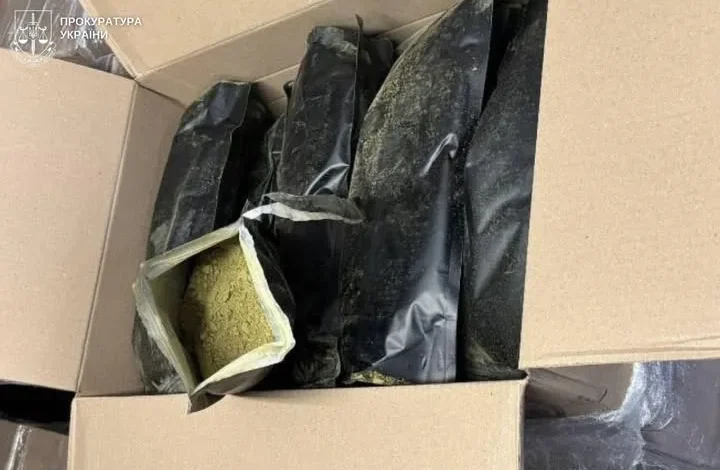
In Lviv region, the activities of a group whose members had organised the large-scale distribution of the narcotic substance “kratom” throughout Ukraine have been halted. According to preliminary data, the monthly income from the sale of this substance at “black” market prices amounted to over UAH 11 million. This was reported by the Lviv Regional Prosecutor’s Office.
According to the investigation, since January this year six men aged between 19 and 34 had set up the illegal movement of kratom into Ukraine and its distribution. In November 2024, the Cabinet of Ministers officially added kratom to the list of narcotic drugs and psychotropic substances. The drug was sourced from EU countries, using private carriers to bypass customs controls.
In Dnipro, members of the group rented an office and five garage units that had been converted into a storage and packaging hub. In one of the garages, kratom was packaged and then distributed to other premises for storage. Sales were carried out without direct contact via Telegram channels, with orders taken and delivery coordinated there. The “goods” were sent by taxi services and logistics companies as ordinary postal consignments, and were sold both at retail and in large wholesale batches.
According to preliminary estimates, over 1 tonne of kratom passed through the packaging facilities every month. To maintain secrecy, the locations where the drugs were packaged and stored, as well as the methods of transportation, were regularly changed. Over time, members of the group focused mainly on large wholesale clients, increasing the minimum order size to 5 kg and narrowing the circle of buyers. Payments were made via electronic crypto-wallets.
In November this year, law enforcement officers detained all six suspects pursuant to Article 208 of the Criminal Procedure Code of Ukraine. During 27 searches at the suspects’ residences, in their vehicles and in premises used for storing and packaging drugs, officers seized more than 1 tonne of kratom, 500 bottles of liquid containing it, 320 smoking devices with tetrahydrocannabinol and almost 80 cartridges for them, cash, equipment for packaging, electronic devices, bank cards and rough notes. The estimated value of the seized illicit substances at “black” market prices exceeds UAH 12 million. In addition, two cars used by members of the group — a BMW 530I and a TOYOTA RAV 4 — have been seized.
Under the procedural guidance of the Lviv Regional Prosecutor’s Office, all six men have been notified that they are suspected of the illegal purchase, storage, transportation and shipment for the purpose of sale, as well as the sale, of narcotic drugs, committed repeatedly, by prior conspiracy by a group of persons, on an especially large scale (Part 3 of Article 307 of the Criminal Code of Ukraine). At the request of the prosecution, the court has chosen custody without the right to bail as a measure of restraint for the suspects.
“Because of advertising, kratom is often seen as a harmless ‘tea’ or a safe tonic, but this is a dangerous illusion. In its effect on the brain it is similar to opioids and causes rapid drug addiction. In seeking to relax, a person ends up with serious damage to the heart, liver and mental health, and an overdose can be fatal. No amount of ‘naturalness’ makes a drug safe,” noted the procedural supervisor in the proceedings, Roman Zamarayev.
Investigative actions are ongoing, a number of forensic examinations have been ordered, and other individuals who may be involved in the unlawful activity are being identified. In particular, the role of employees of the logistics company whose services were used by members of the group to distribute the banned substances is being examined. The pre-trial investigation is being conducted by the Main Department of the National Police in Lviv region with the involvement of officers from the Main Departments of the National Police in Luhansk, Ivano-Frankivsk and Dnipropetrovsk regions. In accordance with Article 62 of the Constitution of Ukraine, a person is presumed innocent of committing a crime until their guilt is proved in the manner prescribed by law and confirmed by a guilty verdict of a court.