

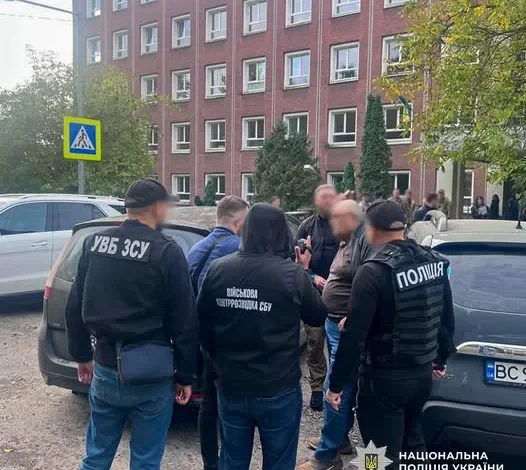
In the Lviv region, a scheme was uncovered under which servicemen were discharged from service on health grounds in return for money, with fraudulent medical diagnoses being issued. This was reported by the National Police.
According to the investigation, those involved in organising the scheme include a former deputy commander of a military unit and a doctor at a departmental medical facility. The man, already retired, sought out among his acquaintances in the military those who wanted to be discharged from service on health grounds and offered them his “assistance”.
In one instance, he offered an active-duty serviceman, for 1,500 US dollars, to arrange an eight-day hospital admission without the person actually staying in hospital. Then, according to him, for 100 dollars there was to be contact with a neurologist who could influence colleagues and ensure the paperwork was completed to have the serviceman declared fit for limited duty.
For creating a plausible medical history, with supposed rehabilitation in a boarding house and inpatient treatment, the perpetrators demanded between 5,000 and 7,000 US dollars. The process of preparing the documents took several months: the serviceman was sent for additional examinations to other doctors, and the doctor herself entered fictitious diagnoses into the medical record, arranged day-patient treatment and referrals to the military medical commission. The “service package” even included an imaginary rehabilitation stay at one of the sanatoriums in Truskavets.
According to the investigation, payment was taken in stages, allegedly to pass money on to other medical staff for the necessary decisions or entries. All actions were coordinated and monitored among the accomplices.
Operatives of the Lviv office of the Internal Security Department of the National Police, investigators of the Lviv region police, together with officers of the Internal Security of the Armed Forces of Ukraine of the Main Directorate of the Military Law and Order Service and the Military Counterintelligence Department of the Security Service of Ukraine, documented the unlawful activity and detained both suspects in accordance with procedural requirements.
They have now been notified that they are under suspicion under Part 2 of Article 28 and Part 3 of Article 369-2 of the Criminal Code of Ukraine (trading in influence). The article provides for a penalty of up to eight years’ imprisonment. Procedural supervision is being carried out by the Lviv Specialised Defence Prosecutor’s Office of the Western Region.
In accordance with Article 62 of the Constitution of Ukraine, a person is presumed innocent of committing a crime and may not be subjected to criminal punishment until their guilt has been proven in the manner prescribed by law and established by a guilty verdict of a court.