

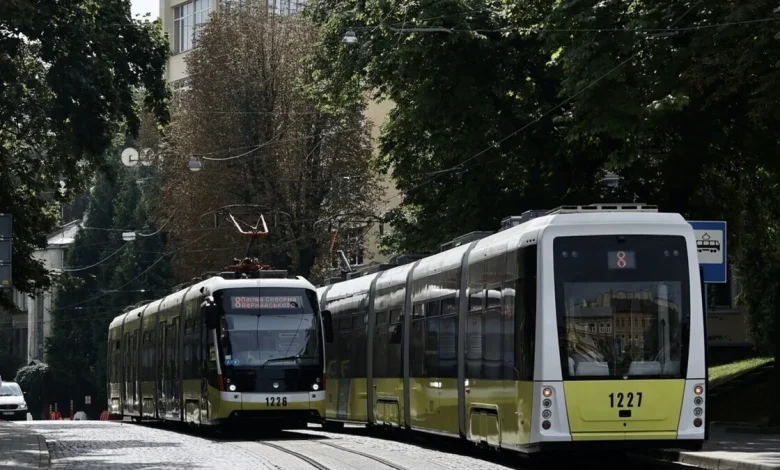
Lviv has begun preparing a large-scale project to make the city’s electric public transport energy-efficient and capable of operating for extended periods without connection to the external power grid. The relevant decision was adopted on 29 October at a plenary meeting of the Lviv City Council, which approved a memorandum on the preparation of financing between the city, the European Bank for Reconstruction and Development and LCE ‘Lvivelektrotrans’.
The document opens up the possibility for ‘Lvivelektrotrans’ to receive a grant of up to EUR 200,000 to develop a feasibility study (FS) for the forthcoming modernisation. The next step will be the selection of an international EBRD consultant, who will carry out the necessary calculations, propose technical solutions, assess the potential electricity savings and the overall effectiveness of the project. The total cost of the modernisation is preliminarily estimated at EUR 21 million, and the issue of the main financing will be considered once the FS has been completed.
Andrii Pavliv, Head of the Investment and Projects Department of the Lviv City Council, noted that the decision in effect launches the first stage of cooperation with the EBRD in this area — the preparation of the FS, which should show how to implement the project technically and what level of electricity savings the city can achieve. In the longer term, this involves attracting loan funds to implement the solutions developed.
LCE ‘Lvivelektrotrans’ emphasises that this is a unique project for Ukraine in the field of energy resilience of critical urban infrastructure. It will combine the development of electric transport, energy storage systems, renewable generation sources and intelligent energy flow management. The aim is to create in Lviv a model of resilient infrastructure in which electric transport not only consumes electricity, but is also integrated into a single municipal energy system.
The key feature of the project is the combination of electricity savings in normal operating mode with energy autonomy in crisis situations. There are plans to connect all ‘Lvivelektrotrans’ traction substations and depots into a single network. According to preliminary calculations, in the event of damage to or loss of external power supply, the system will be able to switch to island mode and provide up to 7.5 hours of autonomous operation for the city’s electric transport. If implemented, this will become one of the most comprehensive solutions in Ukraine to guarantee uninterrupted public transport services.
According to the company, payment for electricity currently accounts for between 25% and 40% of all its costs, depending on the season. International experts with relevant experience are expected to be involved in assessing the future project, in order to select the most effective energy efficiency measures, determine the required volume of investment and works, and calculate the payback period.
Irina Ivanyshyn, Director of LCE ‘Lvivelektrotrans’, stresses that this is a large and ambitious initiative which in the long term should strengthen the resilience of the city’s energy system and reduce the company’s costs. She considers the current decision of the council to be a necessary first step towards the energy independence, resilience and efficiency of Lviv’s electric transport.
The memorandum between the Lviv City Council, the EBRD and LCE ‘Lvivelektrotrans’ was signed on 28 September during a visit to Lviv by the President of the European Bank for Reconstruction and Development, Odile Renaud-Basso. At that time, the parties publicly declared their intention to work together to strengthen the energy resilience of the city’s electric transport.
Lviv has been cooperating with the EBRD since 2008. Over this period, the city has attracted EUR 217 million in loan and grant financing for 12 joint projects, eight of which have already been implemented and another four are in progress. Key areas include the development of electric transport, the introduction of an electronic ticketing system, a biogas project, road repairs and support for the city’s critical infrastructure during the war.
The video version of this material is available at: https://www.youtube.com/embed/W5f7jo7EVWs?feature=oembed