

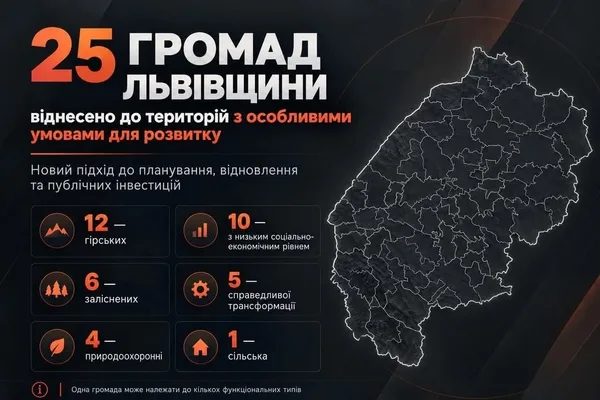
In Lviv Region, 25 territorial communities have been officially classified as areas with special conditions for development. This became possible after, in September, the Government updated its approach to defining functional types of areas, introducing consideration of local specificities when planning their development.
According to the new criteria, the list includes:
- 12 mountain communities, which include settlements with official mountain status;
- 10 communities with a low socio-economic level, characterised by a low tax capacity index;
- 6 forested communities, where forests occupy more than 50% of the territory;
- 5 just transition communities – whose development is linked to the coal industry, the energy sector or the transformation of an industrial economy;
- 4 conservation communities, where protected areas account for more than 20% of their territory;
- 1 rural community, which meets the set of criteria defined by the Government regarding population density, demographic trends and tax capacity.
The total number by individual types exceeds 25, since a single community may simultaneously belong to several area categories.
The Department of Economic Policy of the Lviv Regional State Administration notes that the new approach will enable communities to plan their own development more effectively, taking into account local specificities, to design targeted support instruments, to distribute public investment more efficiently and to promote economic transformation, in particular diversification of the economy in coal areas and the creation of new employment opportunities.
Lviv Region already has experience in this area. The region has prepared a Strategy for the Development of Mountain Areas, a Strategy for the Development of the Lviv Agglomeration with the support of the Council of Europe, as well as an Action Plan for the Just Transition of Coal Areas, developed with the support of the German government through GIZ. These documents take into account the specific characteristics of individual areas and set out the key directions for their further development.