

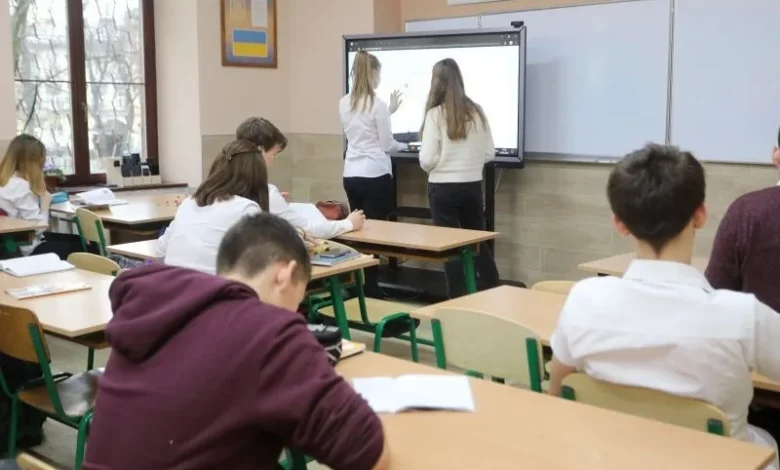
From September, five Lviv schools will move to a new model of specialised upper secondary education and will operate as academic lyceums. These are Lyceum No. 52, School No. 99, the “Lider” School, the Lviv Linguistic Gymnasium and School No. 84 named after Blessed Josaphata Hordashevska. They have been selected as pilot institutions by the Ministry of Education and Science of Ukraine.
These institutions will be the first to introduce teaching under a 12-year upper secondary school programme. Pupils in Years 10–12 will be able to choose an educational track, study certain subjects in greater depth and shape their own educational pathways. It is expected that graduates of 2029 from the pilot lyceums will be able to obtain a bachelor’s degree at university in three years instead of four.
Upper secondary school will last three years — Years 10, 11 and 12. The first term in Year 10 will be an adaptation period: pupils will be able to try out their chosen track and, if necessary, change it during Year 10. In Year 11, specialisation will be strengthened, and in Year 12 the share of specialised subjects will increase to around two thirds of learning time, while other disciplines will be studied in an integrated way.
The pilot lyceums will also introduce a new role for schools: that of careers education adviser. The careers adviser will help pupils choose a track, assess whether it matches their interests, change direction if needed, and will also organise visits to universities, businesses and institutions so that pupils can better understand possible career paths.
«Thanks to the fact that we will have five pilots, five pioneers, we will be able straight away, very quickly and efficiently, keeping our finger on the pulse, to understand what challenges, difficulties or, conversely, discoveries may await our pilots. We will be able to take this into account immediately in the other 41 educational institutions…» — Olesia Mandziuk, Head of the Education Development Department of the Education and Culture Department of Lviv City Council
The Education and Culture Department of Lviv City Council notes that the experience of these five institutions will form the basis for further rolling out the reform in other schools in the city.
Lyceum No. 99 already has experience of taking part in piloting the new state education standard and has completed the first stage of this work. From September, the institution will move to the specialised stage: primary, lower secondary and upper secondary pupils will all study here at the same time. According to the head teacher of Lyceum No. 99, Vira Mokhnatska, the school has introduced pre-specialisation from Year 5, as well as such subjects as STEM, robotics and financial literacy, so pupils approach the choice of track in a more informed way.
Lyceum No. 99 plans to form three Year 10 classes: with advanced study of Ukrainian, English, and a STEM class with a focus on mathematics and computer science. Teachers undertook additional training over the summer and developed special courses. The institution is modernising seven classrooms: creating physics, chemistry and biology laboratories, refurbishing two ICT rooms, as well as mathematics and geography classrooms, and continuing to purchase equipment and furniture.
Lyceum No. 52 has also been included in the list of pilot institutions. Under the new model, 60 upper secondary pupils will study here. The head teacher of Lyceum No. 52 of Lviv City Council, Svitlana Matys, recalls that the decision to transform the school was taken back in 2022, as the reform has been under way for several years. The institution decided to focus on upper secondary education, making mathematics and computer science its priority.
Before launching the new model, the lyceum conducted a survey among Year 9 pupils to identify their educational interests. As a result, four main areas were identified: mathematics and computer science, English, geography and history. The subjects were grouped into three ‘baskets’: two are compulsory according to the chosen track, and the third is chosen by the pupils themselves.
The teaching team of Lyceum No. 52 worked separately with parents and pupils, explaining why schooling will last 12 years and how this will affect subsequent admission to higher education institutions. They emphasised the opportunity to study fewer subjects but to master specialised disciplines in greater depth — those that genuinely interest the pupils.
Full-scale implementation of the specialised upper secondary school reform in Ukraine is planned for the 2027/2028 academic year. It is part of the “New Ukrainian School” reform and envisages the creation of a network of specialised lyceums and a transition to a modern model of organising learning. Lyceums will operate under different structures: Levels I–III (Years 1–12), Levels II–III (Years 5–12) and Level III (Years 10–12.
In Lviv, the final network of educational institutions is already being formed and agreed. According to the Education and Culture Department of Lviv City Council, every school knows its future status and has a roadmap for forthcoming changes. Some institutions will remain primary schools, while some lyceums will combine a primary school and a gymnasium. For example, Lyceum No. 99 will cover all three stages of education and will admit pupils from Year 1.
Lyceum No. 52, by contrast, has already stopped admitting pupils to Year 1 and will not do so in future. By 2034, only pupils in Years 10–12 are expected to remain here, but current pupils will be able to complete their education at their school. For each school, a step-by-step action plan has been defined for every stage of the reform so that the transition to the new model takes place gradually and in a predictable way.
A video about how Lviv’s pilot lyceums are preparing to work under the new model of specialised upper secondary school can be viewed at: https://www.youtube.com/embed/kxZMii4y2ug?feature=oembed