

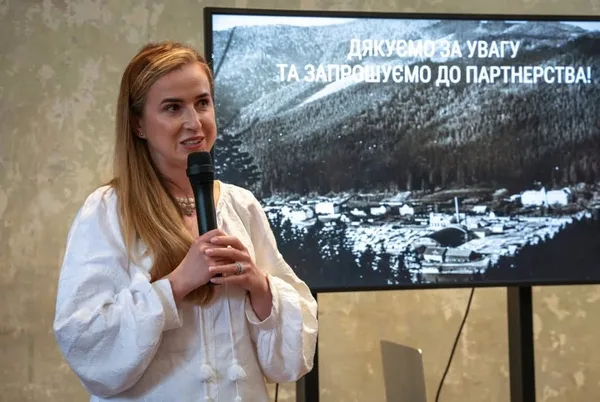
In the town of Skole in Lviv region, a new visitor centre of the Skole Beskids National Nature Park has been unveiled — the “Hredliw Drawing Room”, created in the historic Hredliw Palace. Over the weekend, the space welcomed its first visitors, and around 200 m² of the building has so far been restored for guests.
The “Hredliw Drawing Room” will serve as a starting point for travellers planning trips in the Skole Beskids. Here visitors can obtain information about hiking routes, the region’s nature and history, sign up for guided tours and take part in environmental education activities. The Department of Sport, Youth and Tourism of the Lviv Regional State Administration stresses that it is important not only to increase visitor numbers, but also to improve the quality of the tourism offer and infrastructure, as in just six months the Skole Beskids have been visited by around 90,000 people.
The Hredliw Palace is more than 150 years old. At various times it has been a family residence and a centre of social life in Skole, and it has lived through two world wars, remodellings and changes of use. In 2020, the building was transferred on a long-term lease to the Skole Beskids National Nature Park to create a tourism and environmental education centre, after which the restoration process began.
Vasyl Pryndak, Director of the Skole Beskids National Nature Park, notes that from the outset the idea was to create a tourism hub, whose concept gradually took shape in the course of the work. The Frankfurt Zoological Society in Ukraine (FZS Ukraine) played a crucial role in saving the palace. When the condition of the building deteriorated particularly badly during the full-scale war, the organisation funded urgent repairs to the roof. The works began in 2023 and were completed the following summer. In total, over the period of cooperation, FZS has allocated around 500,000 euros to support the Skole Beskids.
According to Iryna Burbylo, Head of the Protected Areas Infrastructure Department at FZS Ukraine, the emergency roof repairs grew into a broader project that combines preserving the building with developing a vision for its future. In the long term, the palace complex is to become part of an integrated tourism and environmental education infrastructure. The development concept envisages guest rooms, a café or restaurant, conference and event spaces, a park, a greenhouse, children’s areas, walking routes around the palace and premises for civil society organisations.
Cultural manager Mariia Kravchenko emphasises that the palace is being restored in such a way that it immediately engages with visitors, rather than remaining closed after renovation. Keeping the space public is defined as one of the key principles: it is intended to bring together nature conservation, the preservation of cultural heritage and the interests of the local community.
Head of the State Agency for Tourism Development of Ukraine, Nataliia Tabaka, who was among the first to visit the “Hredliw Drawing Room”, described the centre as a “gateway to the Carpathians” and highlighted its importance for the development of the community and the entire Carpathian region. According to her, the project should become a focal point for tourists and businesses, which are already showing interest in restoring guest rooms, thereby helping to increase tourism tax revenues and visitor spending in the region.
The restoration of the Hredliw Palace is being made possible by pooling the resources and efforts of international partners, private donors, local self-government bodies and state institutions. The “Hredliw Drawing Room” is already open to visitors, while the further revitalisation of the palace and the development of the surrounding infrastructure continue.