

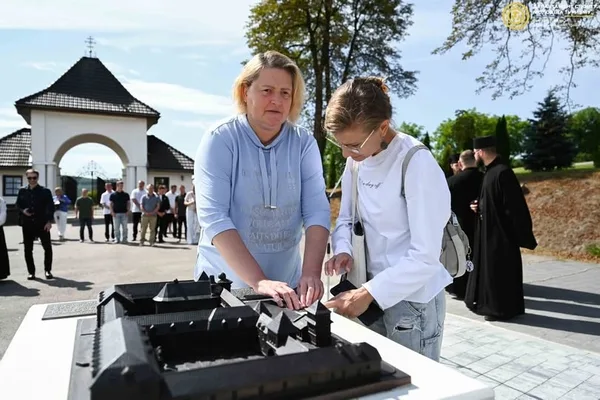
At the Holy Dormition Univ Lavra of the Studite Rule of the UGCC, a bronze tactile mini-sculpture of the monastery complex has been unveiled. This allows people with visual impairments to explore by touch one of the most valuable sacred monuments of the Lviv region, while audio description provides a spoken account of the site. The project was implemented by the Department of Sport, Youth and Tourism of the Lviv Regional State Administration together with Peremyshliany City Council within the Programme for the Development of Tourism and Spas in the Lviv Region.
The mini-sculpture has been installed in the lavra’s park area. The model reproduces the historic part of the complex: the monastery buildings, the inner courtyard, the Church of the Dormition of the Blessed Virgin Mary, the Chapel of the Synaxis of the Blessed Virgin Mary, and the separately located bell tower. Nearby are information boards in Ukrainian and English, duplicated in Braille, as well as a QR code providing access to the audio description.
The total budget of the project is 640 thousand hryvnias. Of this, 440 thousand hryvnias came from the regional budget, and a further 200 thousand hryvnias were co-financed by Peremyshliany City Council. The Lviv Regional State Administration emphasises that the initiative is aimed first and foremost at expanding access to cultural heritage for people with disabilities and developing inclusive tourism in the region.
Deputy Head of the Lviv Regional State Administration Ivan Sobko stressed at the unveiling that such facilities enable people with visual impairments to gain a fuller understanding of historic monuments and should be introduced at other locations across the Lviv region. The hegumen of the Holy Dormition Univ Lavra, Father Josaphat Voytek, noted that the need for a model had long existed, as pilgrims and visitors with visual impairments had repeatedly enquired about the possibility of a tactile introduction to the complex.
The author of the tactile mini-sculpture is the sculptor, Candidate of Art Studies and Associate Professor at the Lviv National Academy of Arts Vasyl Odrekhivskyi. The audio description was prepared by the head of the Resource Centre for Educational and Information Technologies for Persons with Special Needs at the Lviv Polytechnic National University, Oksana Potymko. The text was voiced by audio describer and announcer, and vocalist of the “Pikkardiyska Tertsiya” ensemble, Yaroslav Nudy.
Peremyshliany City Council, which provided 200 thousand hryvnias in co-financing, regards the installation of the model as an important step in promoting Univ Lavra and broadening its accessibility for different categories of visitors. The Mayor of Peremyshliany, Oleksandr Zozulia, stressed that the lavra is one of the key landmarks of the local community, and that the new facility will help open it up still further to people.
Univ Lavra is one of the oldest spiritual centres of Halychyna. The first written references to the monastery date back to the 14th century, and archaeological surveys indicate the presence of earlier sacred and defensive structures on this site. The complex saw intensive development in the 16th–18th centuries. After the Tatar raid and fire of 1549, the rebuilding of the monastery was overseen by the nobleman Oleksandr Vanko Lahodovskyi. Between 1549 and 1574, stone walls with embrasures, four corner towers, moats and earth ramparts were erected around the monastery, forming a powerful defensive system.
In time, the military significance of the monastery diminished, but Univ remained an important spiritual and cultural centre of the region. Parts of the old fortifications, the Dormition Church, the Metropolitan’s Palace and a number of other buildings of the complex have survived to this day. The lavra is associated with the names of Ivan Vyshenskyi, Yov Knyahynytskyi and the Metropolitans Mykhailo Levytskyi and Andrey Sheptytsky. In the 17th–18th centuries a printing house operated here. Today the monastery is included in the tourist guide “Lviv Region. 25 Tourist Magnets” as one of the region’s leading cultural, religious and historic sites.
The Director of the Department of Sport, Youth and Tourism of the Lviv Regional State Administration, Roman Khimyak, stressed that the installation of the tactile mini-sculpture in Univ is part of systematic work to create an inclusive tourist route around the Lviv region, linking landmark sites and enabling people with different needs to engage more fully with cultural heritage.
The tactile mini-sculpture of Univ Lavra is already the fourth such inclusive facility in the region. Earlier, tactile models were installed at the Tustan Historical and Cultural Reserve, as well as in Zhovkva and Drohobych. From now on, an introduction to Univ Lavra can begin not only with viewing its ancient walls and domes, but also with touching the bronze model, reading a few lines in Braille, or listening to the audio description — all of which help make its spiritual and historic heritage more accessible to everyone.