

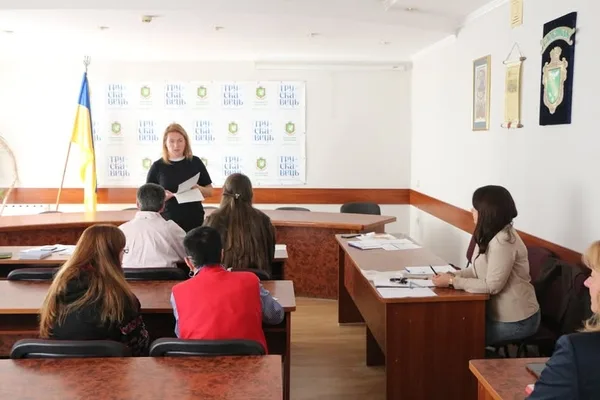
In Truskavets, another meeting of the Council of Internally Displaced Persons took place, during which decisions were developed on additional support for displaced people in the Truskavets community and on improving service provision. The 16 September meeting was chaired by the head of the IDP Council, Nataliia Durytska.
The participants discussed the need to develop a separate Programme for the Protection and Support of Internally Displaced Persons in the Truskavets community. Marina, a representative of the CF “Stabilization Support Services”, stressed that IDPs should be more actively involved in the work of government bodies, commissions and committees, and that a separate programme would help attract additional grant funding. The Foundation has undertaken to draft such a programme.
Secretary of Truskavets City Council Nataliia Ponomarenko reminded those present that all decisions of the city council also apply to displaced persons. Thus, parents of newborns registered in the community receive UAH 10,000 each, regardless of whether they are local residents or IDPs. Service personnel from among displaced persons who have signed a contract receive UAH 30,000 from the city budget, just like other military residents of the community. IDPs are involved in the work of the territorial centre and enjoy the same benefits as locals.
One of the key items was consideration of Resolution No.751 of the Cabinet of Ministers of Ukraine dated 10.06.2026 “On the implementation of an experimental project to provide internally displaced persons with housing in rural areas”. A detailed report was presented by the head of the municipal property department of Truskavets City Council, Olha Seher. She outlined the conditions under which displaced persons can obtain village housing for use: the owner must have a complete set of documents for the house and the land, commission an expert valuation at their own expense, and the housing itself must have electricity, gas, central heating, water supply and sewerage and must not require major repairs. The value of such a property may not exceed UAH 500,000. At the same time, IDPs must not own any other housing in Ukraine, must not purchase land or a car, and other restrictions are also envisaged.
The city council noted that it is working on implementing this project and is preparing proposals at oblast and Cabinet of Ministers level so that those displaced persons who wish to settle in a village have a real chance to take advantage of the programme. A representative of IDPs, Nataliia Durytska, has been included in the commission established by the executive committee to implement the resolution. If concrete housing offers appear, the displaced community will be promptly informed.
The third item on the agenda was equipping the Truskavets Administrative Services Centre with the so-called “digital suitcase” – a set of equipment enabling a specialist to visit residents with limited mobility, in particular persons with disabilities who are bedbound. This will make it possible to provide administrative services at home and will strengthen accessibility in the community. The necessary equipment is expected to be purchased with the support of UNHCR.
Members of the IDP Council also emphasised the importance of up-to-date statistics on displaced persons in the Truskavets community. Data are needed on the number of IDPs broken down by oblasts and communities of origin, age groups (pre-school children, schoolchildren, pensioners), as well as on disability. This information is to be requested from the Pension Fund of Ukraine and the Department of Social Protection of the Population of Truskavets City Council. This is necessary, in particular, for the continued receipt of assistance from the military administrations of Donetsk, Luhansk, Zaporizhzhia, Kharkiv, Kherson and other oblasts.
To gain a better understanding of the needs of internally displaced persons in the Truskavets community, a special survey of IDPs is planned. Additional information will be provided when it begins.
At the end of the meeting, those present discussed the situation with public transport in the city. Participants noted that the quality of services on routes No.2 and No.3 does not satisfy either displaced persons or local residents, so the issue of improving the work of transport operators remains pressing for the community.