

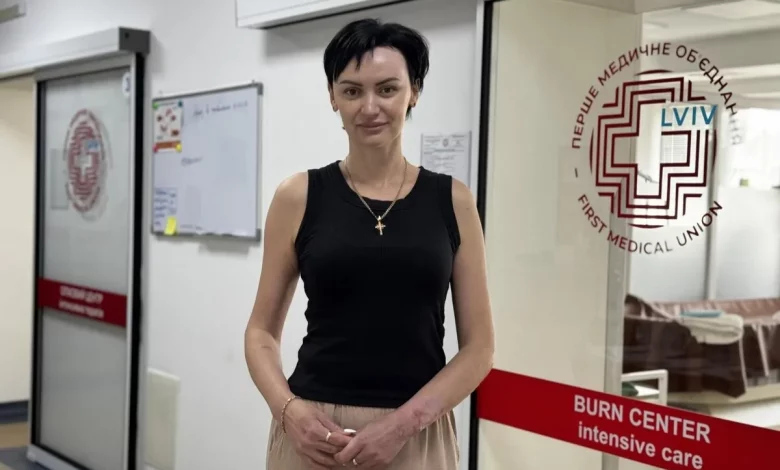
39-year-old Odesa resident Yevheniia Kharchenko, who lost her husband and sustained burns to 45% of her body surface as a result of a Russian Shahed strike on a block of flats in Odesa, is undergoing treatment at the thermal injury and plastic surgery centre of St Luke’s Hospital in Lviv. Here she is being helped to overcome the severe consequences of her injuries within the framework of the “(Not) For Beauty” project, implemented by the UNBROKEN centre together with its partners.
On the night of 31 December 2025, a kamikaze drone hit the nine-storey building where the Kharchenko family lived. In the flat were Yevheniia, her husband Denys and their two children. After the explosion and fire, the woman was trapped under the rubble, suffering burns to almost half of her body, while her husband sustained burns to about 90% of his body surface. Their daughter Valeriia and son Mykola suffered injuries of moderate severity.
The couple received initial medical care in an Odesa hospital. On 1 January, Yevheniia and Denys were airlifted to Lviv, to the thermal injury and plastic surgery centre of St Luke’s Hospital, which is part of the UNBROKEN ecosystem. It was here that the woman last saw her husband alive. Denys was later transferred abroad, but due to the extremely extensive burn area, he could not be saved. He was 42 years old and worked as a patrol police officer.
Yevheniia’s condition was also critical: deep burns to her upper and lower limbs, head and torso. She spent almost two weeks in the intensive care unit in a serious condition. Doctors performed a series of operations to excise dead tissue and close the wounds with her own skin, and carried out numerous dressings under anaesthesia.
Head of the thermal injury and plastic surgery centre at St Luke’s Hospital, Ivan Ryk, says that at the time of admission the patient’s burns were critical — up to 45% of her body surface, and there was a real threat to her life. The medical team is now working to minimise scarring as much as possible, in particular through surgical interventions and CO2 laser treatment.
Yevheniia has become a participant in the “(Not) For Beauty” social project. She has already undergone her first CO2 laser scar resurfacing session. Ahead lie further operations, as large scar masses have formed on her knees, restricting movement and requiring excision.
“Such projects are very important for women at a time like this. Because when you are supported and helped in this way, it gives you the strength to go on living. Above all, I want to regain the confidence and beauty I once had, so that I can put on a dress like before,” the patient adds.
The “(Not) For Beauty” project is aimed at helping Ukrainian women affected by Russian aggression to reduce the visible traces of war on their faces and bodies and to restore their sense of attractiveness and self-confidence. To take part in the initiative, women need to fill in an online application form on the project’s dedicated platform.
The UNBROKEN Centre operates on the basis of the First Medical Association of Lviv. Here, people affected by the war can receive comprehensive care — from emergency surgery and burn treatment to prosthetics, psychological support and rehabilitation. Each patient is treated by a multidisciplinary team of specialists, so all the necessary services are provided in one place, without the need to apply to several different institutions or seek treatment abroad.