

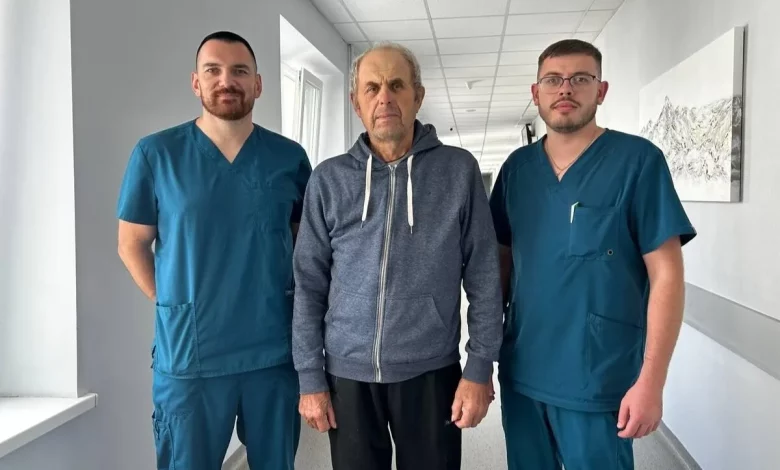
At St Panteleimon Hospital of the First Medical Association of Lviv, doctors carried out complex treatment on a 77-year-old patient with an extremely rare liver tumour that had caused a dangerous drop in blood sugar levels and a hypoglycaemic coma.
Despite his age, Stepan Rebets led an active lifestyle and did farm work. Over time, he began complaining of severe weakness and suspected he had diabetes. He was taken to St Panteleimon Hospital by ambulance in a critical condition, with a very low blood glucose level, after which he fell into a hypoglycaemic coma.
Computed tomography revealed a large mass, about 25×17 centimetres in size, in the upper part of the abdominal cavity. At first, specialists considered the possibility of a pancreatic insulinoma, as a sharp and persistent drop in blood sugar is typical of tumours that produce insulin. However, the size of the mass did not match the usual picture for such tumours.
Further examinations showed that the tumour originated from connective tissue and received its blood supply from the hepatic arteries. The doctors diagnosed a solitary fibrous tumour of the liver. This is a very rare benign mass that, according to statistics, occurs in only 1–3 people per million, and in most cases in the chest cavity, arising from the connective tissue of the pleura. Localisation in the liver is considered a medical anomaly, and it is even rarer for such tumours to produce an insulin-like substance that intensively “draws” sugar from the blood.
Treatment took place in two stages. First, interventional radiologists performed embolisation of the artery feeding the tumour through a puncture of the vessel. This made it possible to significantly reduce its blood supply and stabilise the patient’s condition before the main surgical intervention.
Four days later, the surgical team at St Panteleimon Hospital successfully removed the giant mass. After the operation, Stepan Rebets’s blood glucose level normalised and his overall condition began to improve rapidly.
“I feel well. I still want to drive my tractor, because I don’t like sitting around doing nothing” — Stepan Rebets
The First Medical Association of Lviv notes that its facilities, including St Panteleimon Hospital, provide a full range of modern medical care — from diagnostics and treatment to complex surgical interventions, rehabilitation and prosthetics, including for patients in the most severe conditions.