

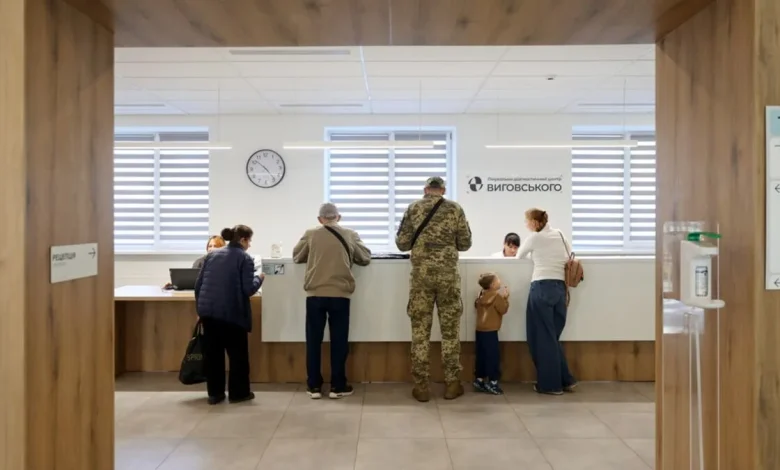
Treatment and diagnostic centres in Lviv, which operate as part of the First and Second Municipal Medical Associations, have significantly expanded their options for examination, treatment and rehabilitation. They are developing day-case surgery, upgrading diagnostic equipment, bringing in highly specialised doctors and strengthening rehabilitation services for adults and children.
One of the key areas of work of the First Medical Association has become day-case surgery. At the Pohulianka TDC on Medovoi Pechery Street, dermatological surgery, oncological dermatological surgery and reconstructive soft tissue surgery have been introduced. Here they remove skin neoplasms and restore tissues after interventions. Similar services are also being developed at the Mazepy TDC.
According to Volodymyr Fedorov, Director of the “Treatment and Diagnostic Centres” branch of the First TMA, in just the past month, 35 outpatient operations have been performed at the surgical department of the Pohulianka TDC, including procedures under general anaesthesia to remove breast fibroadenomas with subsequent histological examination. One example is a two-hour operation for squamous cell skin cancer of the hand with skin grafting, after which the patient returned home the same day and only came back for dressings.
Diagnostic services at Pohulianka have also been expanded: electroencephalography is now available, as are three ultrasound machines, and ultrasound diagnostics at the site on Rymlianyna Street. Patients can consult a breast specialist, mammography volumes have been increased, cardiologists and an oncologist have been added, and 24-hour blood pressure monitoring is carried out by prior appointment.
At the Sykhiv TDC, an updated radiology and functional diagnostics department has been operating since 1 September. Two new X-ray machines have been installed, mammography introduced and breast specialist consultations launched. In addition, fluoroscopy, densitometry for assessing bone density, ultrasound scans, including of the breasts and pelvic organs, are available. At the medical rehabilitation centre they provide pressotherapy, shockwave therapy and phototherapy, and have updated equipment for ultrasound and magnetotherapy. Twenty-five new doctors have joined the Sykhiv TDC team, including an additional rheumatologist.
At the Pivdennyi TDC on 4 Vasyl Symonenka Street, day-case surgery has also been launched. An endoscopist has been recruited, who performs gastroscopy and colonoscopy, expanding the possibilities for diagnosing diseases of the digestive system. Echocardiography, vascular ultrasound, electroencephalography, 24-hour blood pressure monitoring and ECG are available at the centre. The next step is to develop breast services: premises are being prepared and the issue of installing a mammography unit is being resolved, so as to combine mammography, breast specialist consultations and breast ultrasound at all locations of the First TMA.
The Mazepy TDC specialises, in particular, in the treatment of chronic pain – it is home to a Pain Centre. The facility provides functional diagnostics (tilt test, treadmill test), insertion of chemoports, and immunobiological therapy in the day ward. Dermatological surgery, reconstructive soft tissue surgery, breast specialist consultations and day-case surgery are available. According to Volodymyr Fedorov, all TDCs of the First TMA have expanded their physiotherapy options by adding equipment for laser and shockwave therapy.
In Lysynychi, the family practice clinic has been completely refurbished and the range of services available close to home expanded. Blood tests by prior appointment have been introduced, and echocardiography is performed. In addition to family doctors’ consultations, outreach consultations with specialists – a cardiologist, urologist – as well as ultrasound examinations are organised. The TDC team carries out preventive outreach check-ups in the village. Another family practice clinic is being prepared for opening on Sonyashnykova Street, where refurbishment is ongoing.
At the Vyhovskoho TDC of the Second Lviv Medical Association on 32 Vyhovskoho Street, the outpatient rehabilitation department has been upgraded. Patients are seen by doctors in physical and rehabilitation medicine, physical therapists, occupational therapists, and speech and language therapists. Individual and group sessions are available, as is equipment for gait retraining and restoration of joint and hand movements. A 24-hour trauma unit operates with a separate entrance, where patients are examined by a surgeon and a traumatologist, undergo X-rays, have wounds treated and plaster casts applied.
The diagnostic department of the Vyhovskoho TDC provides X-ray examinations, mammography, densitometry, electroencephalography, electromyography and ultrasound, including cardiac ultrasound. For children, neurosonography and ultrasound of the hip joints are performed. Among the specialised services are liver elastography, ultrasound of the vessels of the aortic arch, phototherapy and vascular surgeon consultations. Elastography makes it possible to assess the stiffness of liver tissue and the probable degree of fibrosis, densitometry is used to assess bone density, and phototherapy – as prescribed by a dermatologist – for certain dermatological conditions.
The Vyhovskoho TDC also hosts a Mental Health Centre, where a psychiatrist, psychotherapist and psychologist see patients. Military personnel, veterans and their family members can contact the veteran support office for assistance in arranging medical services.
At the Levandivka TDC on 99 Povitriana Street, 24-hour blood pressure monitoring and 24-hour ECG monitoring are available, which make it possible to track parameters over a full day during usual activity, rest and sleep. The need for these tests is determined by a doctor. A Mental Health Centre operates at the facility: patients are seen by a psychiatrist, psychotherapist and psychologist, and a sexologist has recently joined the team.
Some specialised care for TDC patients can be obtained at other units of the Second Lviv Medical Association. At the Yevhen Ozarkevych Hospital, haematologist, phthisiologist, paediatric endocrinologist and nephrologist consultations are available; liver elastography, joint ultrasound and ultrasound of the vessels of the aortic arch are performed there. At the Prince Lev Hospital, paediatric dermatologist and vascular surgeon consultations and ultrasound of the vessels of the aortic arch are available, and at the Sofiia Okunevska Hospital there are consultations with a child psychiatrist.
All TDCs of the First TMA employ medical coordinators who help patients plan their diagnostic and treatment pathway. Sign language support is available for people with hearing impairments. At all locations in the network, patients can see a vascular surgeon and expert clinicians, undergo comprehensive medical check-ups and psychophysiological assessment. If necessary, after an examination by the on-duty doctor, a patient can be transported by intensive care ambulance to the inpatient facility of the First TMA.
Since 1 May, Lviv polyclinics have been operating as treatment and diagnostic centres within two medical associations: the First and the Second. The First TMA network includes the Mazepy TDC (25 Mazepy Street), Pivdennyi (formerly Polyclinic No. 2, 4 Symonenka Street), Sykhiv (formerly Polyclinic No. 4, 68 Chervonoi Kalyny Avenue), Pohulianka (formerly Polyclinic No. 6, 1 Medovoi Pechery Street). The Second Medical Association brings together the Levandivka TDC (formerly Polyclinic No. 3, 99 Povitriana Street) and the Vyhovskoho TDC (formerly Polyclinic No. 5, 32 Vyhovskoho Street).
Patients can book an appointment with a doctor through the registration desk at their treatment and diagnostic centre, by calling the medical associations, via the Helsi system or online on the websites of the First and Second Lviv Medical Associations. It is recommended to clarify the specific list of examinations, how to prepare for them and the conditions under which they are carried out at the time of making an appointment, while the doctor determines the appropriateness of any particular treatment.