

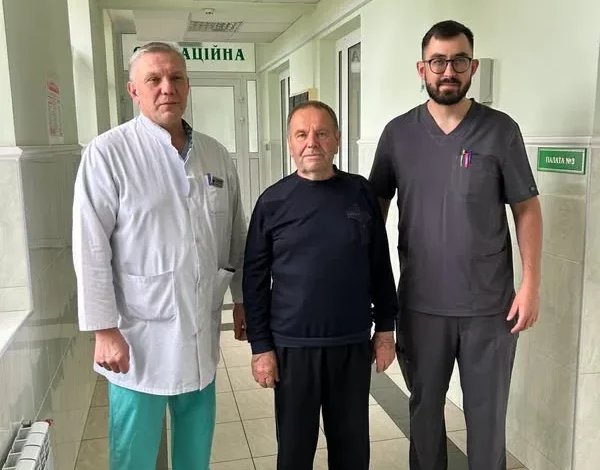
In Lviv, at the Danylo Halytskyi LNMU University Hospital, surgeons of the General Surgery Clinic of the Ohiienko Campus have successfully operated on a 77-year-old patient with a rare combination of four hernia defects at once. The medical facility reported this.
The patient, Bohdan, was diagnosed with bilateral recurrent inguinal hernias and bilateral Spigelian hernias. This was already his fifth hernia operation: previous interventions had been carried out in another facility, but the condition kept recurring, most recently after surgery performed about a year ago.
The man turned to the University Hospital because of hernia protrusions and pain in their area, which intensified during physical exertion. Doctors emphasise that a Spigelian hernia in itself is a rare pathology, accounting for only about 0.1–2% of all hernias of the anterior abdominal wall, and its combination with bilateral recurrent inguinal hernias is extremely uncommon and requires careful treatment planning.
Given the complexity of the case and the considerable scope of the intervention, the team decided to perform the operation in two stages. First, the surgeons carried out alloplasty on the left side, and after the patient had recovered, a month later, they performed a similar operation on the right.
The hospital notes that before the intervention the patient was reviewed by a multidisciplinary prehabilitation board, which determined the optimal treatment strategy and the extent of the operation.
“The multidisciplinary prehabilitation board reviewed the patient and chose the optimal strategy and extent of the intervention. As a result of the two-stage alloplasty, we performed a full reconstruction of both halves of the anterior abdominal wall with preperitoneal placement of large mesh implants measuring 15×25 cm. This provided broad coverage of all existing hernia defects and potentially weak areas, which should significantly reduce the risk of another recurrence,” said Volodymyr Haiduk
During the current intervention, the mesh implants were placed in a deeper layer and were larger than in previous operations. The operation was performed using an open technique, taking into account the patient's concomitant cardiac risks and the recommendations of the cardiac surgeon.
According to the surgeons, the multiple recurrences in this patient are probably related not only to the specifics of previous interventions, but also to a systemic weakness of the connective tissue. The combination of several hernia defects in different areas of the anterior abdominal wall may indicate a general predisposition of the body to hernia formation. Repeat operations also complicate further treatment, as they lead to scar formation and the tissues lose some of their strength, which increases the risk of a new recurrence.
The medical facility stresses that even when a hernia recurs, modern surgical techniques make it possible to successfully correct complex and recurrent cases. Doctors advise not to delay seeing a specialist if a bulge appears in the abdomen or groin, or if there is pain or discomfort, especially during physical exertion. If a hernia protrusion reappears after surgery, it is important to seek medical help as soon as possible.