

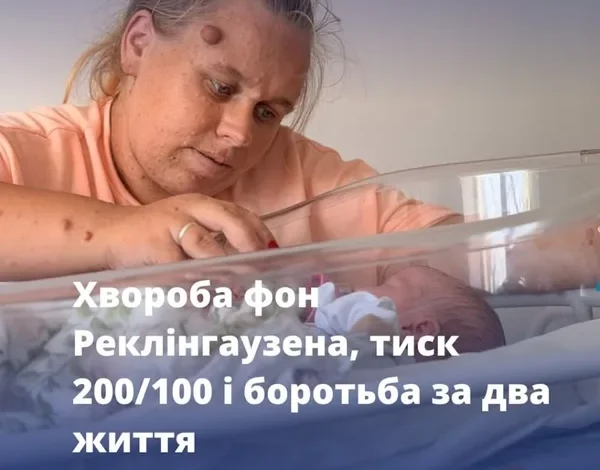
At the Mother and Child Clinic of the University Hospital in Lviv, doctors successfully delivered the baby of 24-year-old Tetiana Baranova from Lviv region, who had a rare genetic disorder and critically high blood pressure. Thanks to the well-coordinated work of the specialist team, they managed to save the lives of both the woman and her newborn son.
Tetiana has become a mother for the third time. Together with her husband, she is raising her six-year-old son Serhii. The previous pregnancy ended in tragedy: at 32 weeks the baby died in utero. During this, her third pregnancy, the risks were again extremely high due to von Recklinghausen disease (neurofibromatosis type I).
This is an inherited disorder of the nervous system, in which tumours – neurofibromas – can form along the nerves. They can affect peripheral nerves, the skin, subcutaneous tissue and, in some cases, the brain. During pregnancy, against the background of hormonal changes, such growths can increase in size, and the risk of complications for both mother and foetus rises; the likelihood of passing the condition on to the child is 50%.
At 36 weeks of pregnancy, the woman was admitted to the Mother and Child Clinic of the University Hospital. One of the main threats was blood pressure of 200/100 mm Hg, which posed a direct danger to the lives of the patient and her unborn child. Obstetricians-gynaecologists, anaesthetists, physicians, neonatologists, neurologists and other specialists were involved in managing the pregnancy, constantly monitoring the condition of the mother and foetus.
Due to the severe course of the disease and the alarming blood pressure readings, the medical team decided to perform a caesarean section. The birth took place at 37 weeks of pregnancy.
“This was an exceptionally complex clinical case. Neurofibromatosis type I is a rare genetic disorder that affects the nervous system and can cause the growth of numerous tumours along the nerves. During pregnancy, the risks increase significantly – blood pressure rises, and serious neurological and cardiovascular complications are possible. That is why we were in a state of constant readiness for surgical intervention,” said Oleksandr Paienok, Professor, obstetrician-gynaecologist at the Mother and Child Clinic of the University Hospital
Following the operation, a baby boy, Matvii, was born. Immediately after birth, his condition suddenly deteriorated: the newborn required resuscitation, intubation, mechanical ventilation, drug therapy and round-the-clock monitoring in the neonatal intensive care unit.
The doctors applied the full range of intensive care, including respiratory support, medical and antibacterial treatment, and continuous monitoring of vital signs. The baby’s condition gradually stabilised, he began to breathe independently, his reflexes improved, and Matvii was then transferred to a joint room with his mother.
Tetiana is now holding her son in her arms and thanking the medical team for saving their lives. She admits that after losing a baby during her previous pregnancy, she was very afraid the situation might repeat itself, but within the walls of the University Hospital she felt safe.
Doctors stress that it is important for women with rare genetic disorders to consult a medical geneticist already at the stage of planning a pregnancy, and subsequently to remain under the care of a multidisciplinary team. Timely diagnosis, careful monitoring and an individually tailored treatment strategy make it possible to cope successfully even with very complex clinical situations.