

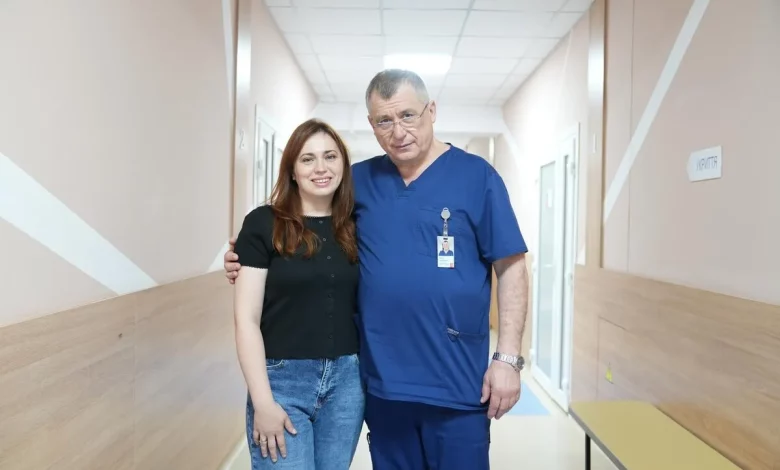
At St Panteleimon Hospital of the First Medical Association of Lviv, maxillofacial surgeons have carried out a unique operation on a 35-year-old Lviv resident with an extremely rare lesion of the temporomandibular joint. For the medical facility and for the lead surgeon with 35 years of experience, this is the first such case.
The patient, Hanna Zozulia, had suffered for around three years from constant pain in the area of the left temporomandibular joint. She underwent numerous examinations, used special splints and consulted various specialists, but for a long time it was not possible to identify the cause of the pain. Only after she turned to the maxillofacial surgeons at St Panteleimon Hospital was the diagnosis finally established.
The head of the head and neck centre, maxillofacial surgeon Oleh Kovtuniak, said he was concerned by a significant malocclusion without any obvious cause, which could have indicated a mechanical obstruction in the joint. After further investigations, the medical team determined that the patient had synovial chondromatosis of the temporomandibular joint. According to the surgeon, this is the first such case in his 35 years of practice.
Synovial chondromatosis is a rare benign tumour-like lesion in which multiple cartilaginous nodules form in the synovial membrane of a joint. They restrict joint movement, alter the bite, cause chronic inflammation and gradual destruction of the cartilage. This condition usually affects large joints that bear significant loads, particularly the hip, knee and elbow. Involvement of the temporomandibular joint is very rare, accounting for less than 3% of all cases of this pathology.
The only effective treatment is surgery, to which Hanna agreed. During the operation, the surgeons completely removed the pathological formations together with the synovial membrane. The situation was complicated by the fact that the cartilaginous nodules were located in the upper part of the left temporomandibular joint, next to a major artery, which created a risk of massive bleeding and required extremely precise work.
The operation was successful. The patient is now feeling well, the postoperative wounds have healed, and the pain that had troubled her for years has disappeared.
“We spent three years looking for the cause. It only kept getting worse. The greatest relief I felt was when Oleh Semenovych finally found what the problem was, and I realised I would no longer have to live with this pain. I am very grateful to the whole team of specialists for their work and professionalism. And I thank the Lord God that everything turned out well,” says Hanna.
The First Medical Association of Lviv notes that it provides a full range of modern medical care, from diagnostics and treatment to complex surgical interventions, rehabilitation and prosthetics, including for patients in severe conditions and after serious injuries.