

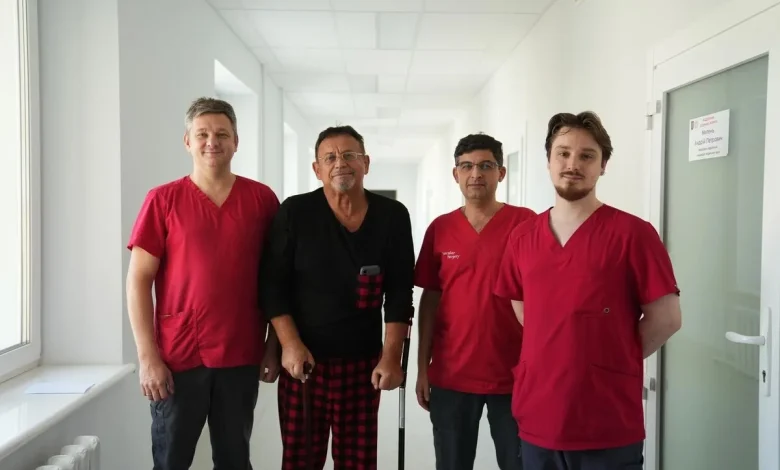
At St Panteleimon Hospital of the First Medical Association of Lviv, vascular surgeons performed a complex operation on a 62-year-old resident of Khmelnytskyi and restored the blood supply to both legs, preventing a possible amputation. The medical facility reported the successful intervention.
Patient Yurii had previously led an active lifestyle, playing tennis and practising hand-to-hand combat. In 2016, his kidneys failed and he began receiving haemodialysis. Doctors note that terminal renal failure significantly increases the risk of severe vascular lesions.
About a month ago, the man felt severe pain and coldness in his legs and soon was unable to walk even a few steps. After an examination in Khmelnytskyi, he was advised to consult vascular surgeons in Lviv. At St Panteleimon Hospital, doctors diagnosed the patient with Leriche syndrome — a severe form of atherosclerosis in which the aorta and iliac arteries supplying the lower limbs become narrowed or blocked. The man already had critical ischaemia, and a trophic ulcer had formed on one leg.
Head of the Vascular Surgery Department at St Panteleimon Hospital, Andrii Melen, explained that drug therapy in such a situation could no longer help, and surgery was the only chance to save the legs. Without surgical intervention, the ischaemia would have progressed, and necrotic changes could have led to amputation.
The surgical team performed bifurcation aortofemoral bypass grafting: the affected segment of the abdominal aorta was replaced with an artificial graft, which was connected to the femoral arteries. The course of the operation was complicated by several concomitant pathologies. In particular, due to pronounced calcification, the aortic wall had become hard and brittle, so calcium deposits had to be removed at the anastomosis site to securely suture the graft.
Another problem was critical stenosis of the superior mesenteric artery, which, together with the inferior mesenteric artery, supplies blood to the intestines. In typical cases during such grafting, the inferior mesenteric artery is ligated, but in this patient it could have caused a serious impairment of intestinal blood supply. Therefore, the surgeons reimplanted this vessel directly into the graft to preserve blood flow.
The complex intervention was successfully completed: the doctors managed to restore the blood supply to both lower limbs and ensure adequate blood flow to the intestines. The patient’s condition is improving, and he is gradually regaining mobility.
“Both before the operation and now, I’m in a fighting mood. My legs are already warmer, and it’s getting easier to walk every day. The doctors here are simply angels. I’m very grateful to them for everything,” says Mr Yurii.
The First Medical Association of Lviv notes that it provides a full range of modern medical care — from diagnostics and conservative treatment to high-tech surgical interventions, rehabilitation and prosthetics. The association includes St Panteleimon, St Luke, St Nicholas and St Anna hospitals, the UNBROKEN rehabilitation centre, and treatment and diagnostic centres.