

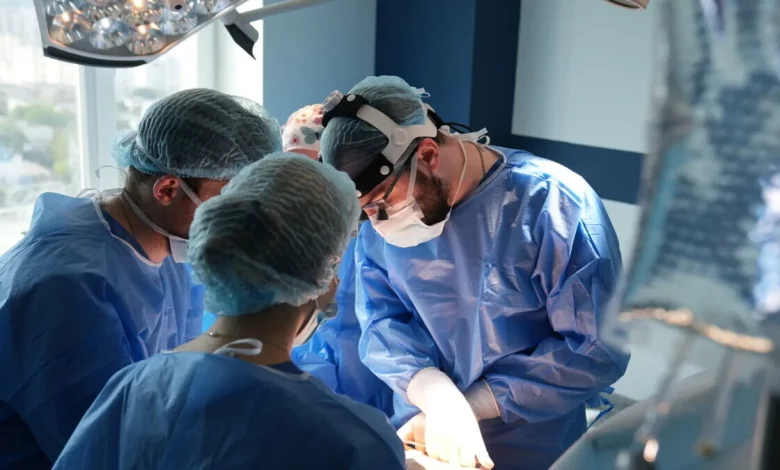
At the UNBROKEN Centre, based at the First Medical Association of Lviv, ophthalmologists carried out a complex operation to transplant a corneal bioimplant for 50-year-old serviceman Oleksandr Skachko from Kirovohrad region, who had almost completely lost his sight after being wounded.
The fighter from the 63rd Separate Mobile Brigade sustained severe injuries in Donetsk region in the winter of this year. While on a combat mission, an enemy FPV drone hit the windscreen of the vehicle he was in. As a result of the explosion, the man lost an arm, his legs were shattered, and his jaw, eardrums and eyes were damaged.
After receiving first aid at a stabilisation point, Oleksandr was treated by doctors in Kharkiv, Kyiv and Lviv. In the capital, he spent about 20 days in intensive care on a ventilator. Later, the patient learnt that he had lost not only an arm and his hearing, but also almost all his sight.
When the soldier was transferred to the UNBROKEN Centre in Lviv, ophthalmologists focused on saving his left eye. Because of a traumatic corneal injury, a scar had formed there, and an inflammatory process was developing in the area of the sutures, which required urgent intervention, as it threatened not only further deterioration of vision but also the loss of the eye.
As soon as donor material became available, the doctors performed a corneal bioimplant transplant. The operation was successful, and vision in the operated eye was partially restored.
“The difference between how I see now and how I saw before is huge. Back then everything was dim. And now my wife is standing in front of me — I can see her, and that is happiness. Now I dream of seeing my granddaughter again; I last saw her in 2022,” says Oleksandr Skachko.
Doctors emphasise that shrapnel, blast and gunshot wounds often cause severe damage to the cornea and frequently result in complete loss of sight. According to their data, eye injuries now account for about 10% of all wounds sustained by military personnel and civilians because of the war. In half of such cases this leads to blindness in one eye, and in approximately 20% — in both.
Because of this, the need for corneal transplants in Ukraine is constantly growing, and for many patients transplantation is the only chance to see again. At the First Medical Association of Lviv, the field of corneal transplantation is being actively developed so that as many people injured in the war as possible can have the opportunity to restore their sight.
The UNBROKEN Centre in Lviv operates as a multidisciplinary hub providing assistance to those affected by the war: each patient is cared for by a team of specialists — surgeons, trauma surgeons, prosthetists, psychotherapists and rehabilitation therapists — which makes it possible to combine treatment and rehabilitation in one place.