

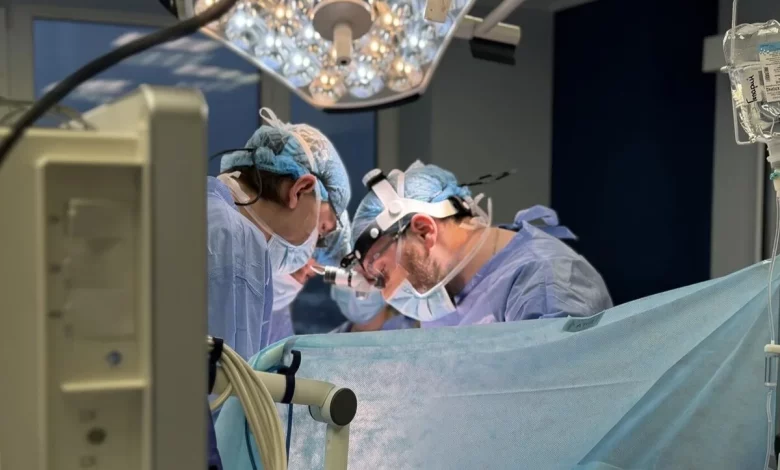
At St Panteleimon Hospital of the First Medical Association of Lviv, surgeons performed a complex operation on a 44-year-old patient with a rare parasitic liver lesion that had long been masquerading as a malignant tumour. The medical team managed to completely remove the growth while preserving as much functional liver tissue as possible.
Yevheniia Bovdrych from the settlement of Borynia in the Lviv region first felt heaviness, discomfort and spasms under her right rib about two years ago. At first, she did not pay much attention to this, but over time the symptoms intensified and she sought medical help. During an ultrasound examination, local doctors detected an enlarged liver and a suspicious mass that required more detailed diagnostics.
At that time, a team of surgeons from the First Medical Association of Lviv was carrying out an outreach consultation in Turka. After examining her, they invited the patient to Lviv for further tests. A CT scan showed signs of a parasitic liver lesion, but the doctors could not completely rule out an oncological process. Only histological examination confirmed the final diagnosis: the woman was found to have hepatic alveococcosis.
Alveococcosis is a rare parasitic disease that behaves in the human body in a similar way to a cancerous tumour: it gradually grows, destroys the liver and can invade neighbouring tissues. The main carriers of the parasite are wild carnivorous animals, particularly foxes and wolves. Humans become infected via the faecal-oral route — while picking berries and mushrooms, drinking water from open reservoirs or coming into contact with soil that may contain the parasite’s eggs.
The only effective method of treating such a lesion is surgical removal of the affected part of the liver, and in severe cases an organ transplant may be required. According to preliminary estimates, the plan for Yevheniia was to remove about 55% of her liver. However, during the operation the surgeons managed to preserve a significantly larger volume of healthy tissue — the resection amounted to only 18% of the organ, exceeding even the most optimistic forecasts.
«The operation was technically challenging. First, we identified the vessels supplying blood to the affected area so as not to damage them during the resection. To do this, we controlled the Glissonian pedicle — the complex that includes the bile duct, a branch of the portal vein and the hepatic artery of the corresponding segment. This allowed us to isolate the affected area and remove it safely, while preserving the blood supply to the rest of the liver», said Volodymyr Diatel
The surgical team performed an anatomical resection of the right anterior section of the liver, preserving as much unaffected tissue as possible. The patient’s recovery went well, and by the tenth day after surgery she was able to return home.
Doctors emphasise the importance of preventing parasitic diseases. In particular, they advise washing hands thoroughly, not eating unwashed wild berries straight from the bush, not drinking unboiled water from open sources, and regularly deworming domestic animals.
The First Medical Association of Lviv provides a full range of modern medical care — from diagnostics and conservative treatment to complex surgical interventions, rehabilitation and prosthetics. Its structure includes St Panteleimon, St Luke, St Nicholas and St Anna hospitals, the UNBROKEN rehabilitation centre, and treatment and diagnostic centres.