

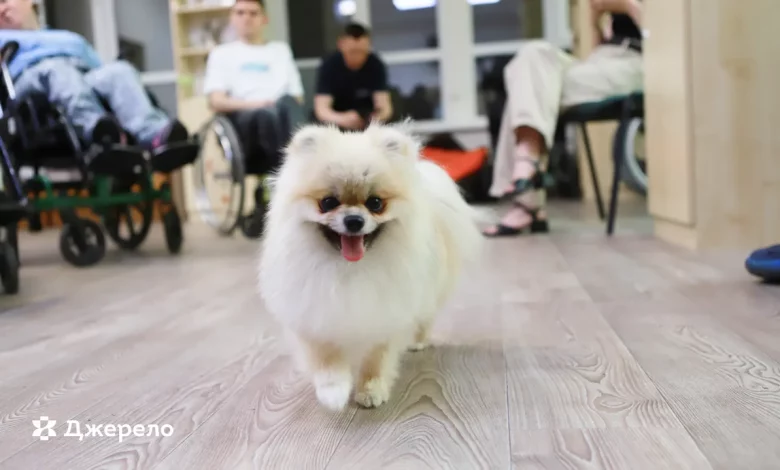
The Dzherelo centre in Lviv has been running a canine therapy programme for over a year now: every Thursday specially trained dogs visit children and young people with disabilities. During these sessions they play with those attending, allow themselves to be hugged and create a sense of calm and safety.
Four dogs are involved in the sessions. Two of them are already accredited as therapy dogs, while the other two have completed training at a canine centre and are preparing to take their main exam. The dogs come to Dzherelo together with teacher and early development specialist Inna Doroniuk.
The canine therapy project at the centre became possible thanks to the charity The Bridge of Life. Its founders, Edward Vain and Tetiana Trikovich, proposed implementing this initiative and supported the building of the team. This is how two retrievers — Alto and Yuki — came to Dzherelo. Two more dogs — Chakki and Karasyk — work together with Inna: Chakki is her pet, and Karasyk was given specifically for sessions with children and young people.
According to Inna Doroniuk, each dog has its own character and interacts with people in its own way. Small in size, Karasyk helps those who are afraid of dogs: thanks to his “toy-like” appearance, children and adults calm down more quickly around him and find it easier to engage. Chakki has a special story: as a puppy he was thrown out into the freezing cold and somehow survived. Inna spent two months fighting for his life and now the dog works with people and is very sensitive to how they are feeling.
The specialist explains that Chakki often goes up on his own to those who need it: he might quietly sit down next to them, rest his head on their knees or curl up in their arms and simply stay by their side. Physical contact with the animal is soothing and helps to build an emotional connection.
Before starting to work with people, the dogs go through a lengthy preparation process. First, the animal's owner receives training, followed by sessions at a canine centre, and then practice with patients. Only after that does the “person + dog” team take an exam and become eligible for accreditation to carry out therapeutic work.
Inna Doroniuk notes that canine therapy affects not only emotional wellbeing but also physical development. During the sessions with the dogs, children and young people improve their ability to concentrate, become more physically active and show more emotional responses. The animal gently stimulates the nervous system and helps even those who usually stay withdrawn to open up.
“Dogs have a very positive effect on psycho-emotional wellbeing and cognitive functions. The ability to concentrate improves, physical activity increases, and emotional processes that might not have manifested before are activated. At the same time, canine therapy is not a universal method — it has to be tried,” says Inna Doroniuk
The specialist stresses that some children do not want to interact with the dog from the very first meeting, while there are others from whom fear or aggression might be expected, but next to the animal they suddenly relax and calm down. That is why each case is considered individually.
Over the course of a year of sessions, the dogs have become true friends for many of Dzherelo's attendees. Everyone here already knows that Thursday is the day when the four-legged visitors arrive, and they are always eagerly awaited. Children are happy not only to see a particular dog, but also simply to have the chance to meet and spend time together.
The centre emphasises that the main task of therapy dogs is simply to be there, to give the opportunity to touch, to hug, to play. For many, this is enough to reduce anxiety, lift their mood and feel supported.
The day care departments of the Dzherelo Centre for children with disabilities are located at: prospekt Chervonoi Kalyny, 86A; vul. Mykolaychuka, 24; vul. Volodymyra Velykoho, 40; m. Vynnyky, vul. Halytska, 12. For young people, departments operate at: prospekt Chervonoi Kalyny, 86A; vul. Roksolany, 23; vul. Patona, 17; vul. B. Khmelnytskoho, 195; vul. Kyrylivska, 3A; vul. V. Velykoho, 40.