

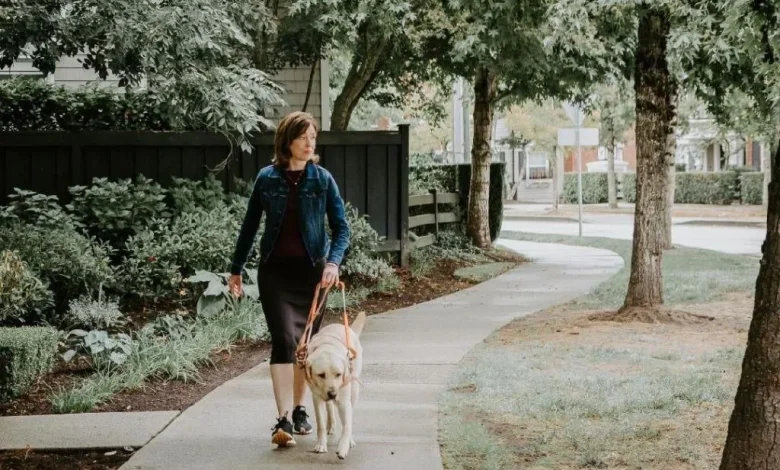
Fifty-six-year-old Lynn Jensen, who lost her sight at the age of 27, will be coming to share her own experiences of travelling and living independently with people who have visual impairments. At the end of November, she will speak to members of the South Surrey/White Rock Low Vision Support Group, which meets at Cranberry Lane, 15241 18 Ave.
Jensen lives in Port Moody and has been travelling the world with guide dogs for more than two decades. She says her first guide dog, a yellow Labrador called Mae, visited 13 countries, 14 US states, five provinces and one territory over eight and a half years. The author now gets around with her fourth guide dog, a Labrador named Quest, and devotes more of her time to teaching other people with sight loss.
At the South Surrey/White Rock Low Vision Support Group, Jensen will present her book “Best Kept Secrets for Travelers with Sight Loss” and talk about strategies for independent living with a visual impairment. Group co-coordinator Jane Klein notes that travel for people with sight loss is “a very serious challenge”, and that the speaker’s advice helps people to overcome a range of fears that relate not only to travelling but also to everyday life.
Jensen stresses that her book is about making journeys safe and enjoyable. It is based on more than 20 years of personal experience following a brain injury that caused her to lose her sight shortly after graduating from the University of British Columbia’s Faculty of Medicine. Her first trips after the diagnosis were far from easy: she admits she was afraid to go anywhere, but returning to Hawaii with her identical twin sister helped her realise that travelling is not just about “views for the eyes”, but also sounds, smells, food and spending time with loved ones, including guide dogs.
The topics of her talk will include international travel, the specifics of travelling with a guide dog, tips on packing and preparing for different situations on the road. She also plans to share skills described in the book, including methods of organising money and basic self-defence techniques. According to Jensen, this knowledge will be useful not only for people with visual impairments, but also for their relatives, friends, carers and anyone who wants a better understanding of how to interact appropriately with someone who has low vision.
Jane Klein emphasises that the South Surrey/White Rock Low Vision Support Group has been an important resource for local residents with visual impairments for more than 20 years. Meetings are held monthly, on the fourth Thursday, from 1pm to 2pm, and usually attract around 20–30 participants. Those taking part are not limited to people with sight loss; family members and carers are also welcome. The focus is on “learning to live well with a visual impairment”, regardless of its degree or cause.
Klein came to the group on the advice of her father, who had macular degeneration, a condition that affects central vision. Among other common causes of sight loss, she names glaucoma and diabetic retinopathy. She says such diagnoses often frighten people, and the aim of the club is to ease that fear by highlighting practical solutions and sources of support.
Most members of the South Surrey/White Rock Low Vision Support Group live on the Semiahmoo Peninsula, but the club’s example has already inspired others. Several participants who previously travelled in from Langley have set up a separate support group there at the Langley Senior Resources Society (20605 51B Ave.), which meets from 1:30pm to 3:30pm on the first Wednesday of the month. According to Klein, 27 people attended the new group’s first meeting.
The organisers of the South Surrey/White Rock Low Vision Support Group stress that the main value of the meetings is the mutual exchange of experience. Some useful information comes from guest speakers such as Lynn Jensen, and some from the members themselves, as they share how they cope with the day-to-day challenges of living with sight loss.