

At the old Holosko Cemetery in Lviv a lengthy joint Ukrainian-Polish exhumation expedition has been completed, during which military burials dating from the defence of the city in September 1939 were examined. The work lasted for more than a month on a plot of about 260 sq m.
Archaeologists and search specialists established that there had been 133 individual graves in this area. In total, the remains of 115 soldiers of the Polish Army and 18 soldiers of the German Wehrmacht were exhumed. According to the head of the NGO “War Victims Search Society “Pamyat”” Liubomyr Horbach, all the fallen had been buried in separate graves arranged in three tightly packed rows without the usual paths, most likely by local residents. After checking the area, no fourth row of burials was found.
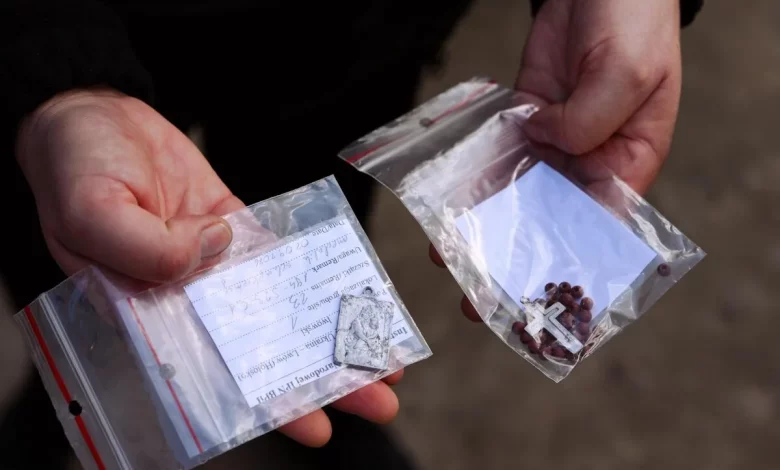
During the works, around 2,900 items were discovered: elements of military uniforms and equipment, religious objects and personal belongings. Whether the fallen had belonged to the Polish or German army was determined mainly from buttons and other details of their clothing. Among the Polish servicemen, seven identity tags were found, six of which had been filled in. The data on them confirm that these were servicemen of Polish nationality and Catholic faith.
One tag turned out to be blank. Beside this burial a Greek Catholic crucifix was found which, according to Liubomyr Horbach, indicates the deceased was of Ukrainian origin. The researcher suggests he was mobilised shortly before the fighting and did not have time to have his details inscribed on the tag. Horbach also stressed that among the servicemen of the Polish Army who defended Lviv there may have been other Ukrainians conscripted from Rivne region, Volhynia, Lviv region and directly from Lviv.
Among the German soldiers, seven had identifiers. It has been established that they all served in the 98th Regiment of the 1st Mountain Division of the Wehrmacht, which fought against the Polish garrison on the western outskirts of Lviv. The remains of these servicemen have been handed over to representatives of the organisation Volksbund, which is responsible for the search and burial of German soldiers; they will be reinterred at the collective military cemetery in the village of Potelychi in Lviv region.
As for the fallen soldiers of the Polish Army, specialists have taken bone tissue samples for DNA analysis in order to establish their identities. Once identification procedures have been completed, the remains are to be reburied at the cemetery in Mostyska. Dominika Siemińska, a representative of Poland’s Institute of National Remembrance, said that a list of 76 possible surnames of the dead had already been compiled, but that because of the time that has passed it would be difficult to trace their relatives.
For us, the identification of the remains is the most important stage of our work, because it is vital to restore these people’s names. And this matters to their descendants as well, said Dominika Siemińska.
She also thanked Lviv for its support in organising the expedition. Lviv City Council emphasised that the city had provided the search team with the necessary conditions: security at the site, public order protection and the preparation of the area before work began. Marianna Moroz, deputy director of the Cultural Heritage Protection Office of Lviv City Council, underlined that such cooperation helps to study shared history more deeply and to pay proper tribute to the fallen.
The search and exhumation works at the old Holosko Cemetery began on 25 August. Around 30 specialists took part in the expedition: representatives of the Ukrainian War Victims Search Society “Pamyat”, the Institutes of National Remembrance of Ukraine and Poland, as well as the memorial and search centre “Dolia”. The work was carried out on the basis of permits from the Ministry of Culture of Ukraine, the State Interdepartmental Commission for the Commemoration of the Victims of Wars, Political Repressions and Participants of the Anti-Terrorist Operation, and the Ukrainian Institute of National Remembrance, following a request by the NGO “War Victims Search Society “Pamyat””.
The first research at Holosko Cemetery was initiated by the Polish Institute of National Remembrance back in 2010. In 2019, search works were resumed in cooperation with the Pamyat Society and the Lviv Children’s Scout Troop “Barć” of the Polish Scouting and Guiding Association in the Western Regions of Ukraine. At that time it was possible to clarify the boundaries of the military cemetery, after which the Ukrainian side prepared and submitted to the State Interdepartmental Commission in Kyiv a package of documents for the Polish side to carry out exhumations.
The next stage, namely the exhumation works themselves, was postponed for a long time because of a pause in the Ukrainian-Polish dialogue on issues of historical memory. In 2024, the Pamyat Society applied to the Ministry of Culture of Ukraine with an initiative to resume measures for the preservation of Polish military burials from 1939 in Lviv. After an official request from the Polish side in 2025, the process moved into the practical phase.
The first stage of reburials of soldiers of the Polish Army who died during the defence of Lviv took place in August 2025. Over more than four weeks, a joint expedition worked on the territory of the former cemetery in Zboiska where, according to Liubomyr Horbach, the remains of 34 soldiers were found.
A video report on the completion of the exhumation works at Holosko Cemetery can be viewed at the following link: https://www.youtube.com/embed/5knsOT6PsMo?feature=oembed