

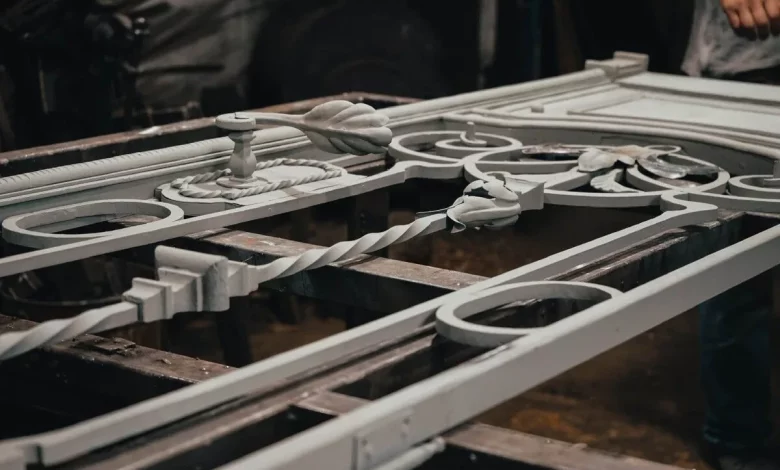
In Lviv, restoration is under way on the metal Secession-style gateway of the building at 22 Stryiska Street. During the work, specialists discovered the structure’s original green colour beneath later paint layers and are recreating the lost decorative elements to return it to its historic appearance. This was reported by the LCP “Bureau of Heritage”.
The restoration of the gateway is being carried out under the supervision of restorer Yurii Mykolaishyn. Research has shown that one of the greatest losses was the original fanlight measuring 210 × 140 cm. A similar element is also missing from the gateway of the neighbouring building, No. 24. The original internal and external latches have not survived either, nor have certain details of the artistic ironwork on the door leaves and the central fanlight.
At the same time, restorers have been able to trace the original decoration thanks to other similar gateways in the city. The “Bureau of Heritage” noted that such metal Secession-style gateways are also found in other districts of Lviv, which indicates their serial production, probably at the Ivan Levynskyi factory. In particular, counterparts have survived in Sevastopolska Street and Verkhratskoho Street, and these have served as models for recreating the authentic internal and external latches.
The historic appearance of the fanlight has not fully survived to the present day, so its structure is being designed on the basis of other Lviv Secession gateways, taking into account the stylistics of the early 20th century and modern safety requirements. At the same time, frames for glazing are being restored, which will make it possible to dismantle the glass safely for cleaning and maintenance without damaging the historic metal base.
A separate stage involves the production, based on historical counterparts, of the lost elements of artistic ironwork on the door leaves and the central fanlight. This will make it possible to restore the gateway’s original artistic composition. The project also includes repairing the lower part of the gateway and the frame, which have been damaged by corrosion due to the gradual raising of the pavement level over the decades.
Once all stages of the restoration are complete, the restored Secession gateway will once again adorn the building at 22 Stryiska Street in its historic form and authentic green colour. The work is being carried out under the city’s co-financing programme for the restoration of valuable elements in buildings within Lviv’s historic area.
Under this programme, in 2025 nine gateways in residential buildings in the historic part of the city were restored jointly with residents, at the following addresses: 20 Hrushevskoho Street; 12 Ostrianytsi Street; 16 K. Levytskoho Street; 3 I. Franka Street; 5 Voronoho Street; 44 Sheptytskykh Street; 25 Kubiiyovycha Street; 11 Drukarska Street and 29 Konovaltsia Street. Ten windows and balcony doors at five addresses were also renewed, and six plastic windows with balcony units were replaced with wooden ones at three addresses.
The buildings Nos. 22, 24 and 26 on Stryiska Street are considered one of the best-preserved ensembles of Lviv Secession development from the early 20th century. They were erected in 1906 to a design by architect Napoleon Lushkevych, and the construction work was carried out by the renowned firm of Ivan Levynskyi. The façades of these tenement houses stand out for their rich decorative design in the Secession style: mascarons, plant ornaments and refined stucco work.
The ensemble also has a notable history of residents. At No. 22 lived sculptor Petro Harasymovych and Professor Kazimierz Květnievskyi, while at No. 26 lived the prominent pharmacologist Leon Popielski. From 1911 to 1939, one of these buildings was home to the world-famous anthropologist Jan Czekanowski, who gained international recognition thanks to his scientific expeditions to Africa.