

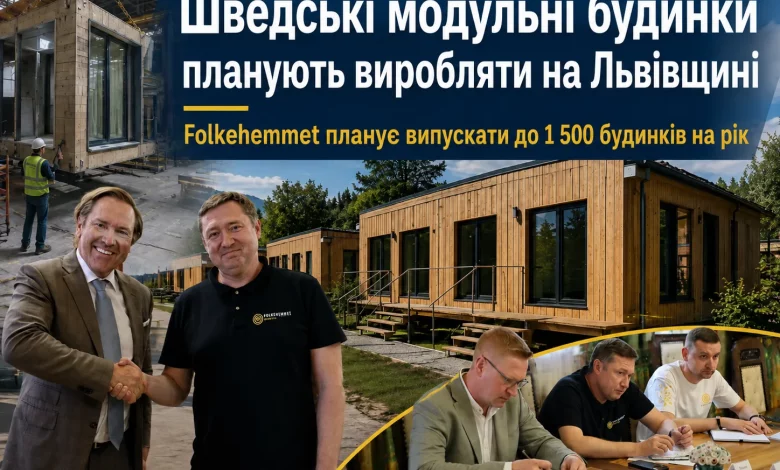
Swedish Modular Home Factory Could Bring 225 Jobs to Ukraine’s Lviv Region
A Swedish company is preparing an ambitious modular housing project in western Ukraine that could produce up to 1,500 fully equipped wooden buildings every year.
Folkehemmet is considering the Lviv region as the location for what regional officials describe as one of Ukraine’s largest modular home manufacturing facilities.
The project could also create up to 225 jobs, with a strong focus on training and employing Ukrainian military veterans.
Swedish modules could arrive before the factory opens
The plans were discussed during a meeting between Maksym Kozytskyi, Head of the Lviv Regional Military Administration, and Folkehemmet managing partner Johan Berglund.
At the first stage, completed modules could be delivered from Sweden while the company develops its own production capacity in Ukraine.
Folkehemmet has also indicated that it may relocate a manufacturing line from Sweden to the Lviv region.
Regional authorities say they are ready to help the investor select a suitable site, work with local communities and manage administrative procedures.
Homes, schools and clinics from the same production line
The factory would focus on energy-efficient wooden modules built to European quality and construction standards.
The buildings are expected to leave the production line almost ready for use, with interior finishing and key engineering systems already installed.
The same modular system could be used to build private homes, schools, medical facilities, administrative offices and other public infrastructure.
This flexibility could make the project especially relevant for Ukraine, where demand remains high for new housing and the rapid reconstruction of damaged social facilities.
Up to 225 jobs, including positions for veterans
Veteran employment is expected to become one of the project’s main social components.
According to the Lviv Regional Military Administration, the first stage could create around 75 jobs for Ukrainian veterans.
Once the factory reaches full capacity, that number could rise to approximately 225.
The company is also interested in working with Ukrainian universities, vocational schools, timber processors and local manufacturers.
This could create additional orders for producers of windows, doors, insulation, furniture, electrical equipment and plumbing systems.
How modular wooden buildings are made
Folkehemmet has not yet published a detailed technical description of the production system planned for Ukraine.
However, the project appears to follow the volumetric timber construction model widely used in Sweden and other Nordic countries.
Walls, floors and ceilings are manufactured inside a controlled factory environment and assembled into complete three-dimensional modules.
Kitchens, bathrooms, flooring, doors, electrical wiring and parts of the heating and plumbing systems can be installed before the modules are transported.
The completed units are then delivered by truck and placed onto prepared foundations using cranes.
This method can significantly reduce the amount of construction work required on site and limit delays caused by weather.
Why the project could matter for western Ukraine
A plant capable of producing 1,500 buildings a year could become a major industrial investment for the Lviv region.
Beyond direct employment, it could generate demand for Ukrainian timber, construction materials, logistics, engineering services and locally manufactured components.
Modular construction also allows several stages of a project to take place at the same time.
While foundations and utility connections are being prepared at the site, the building itself can already be assembled and finished inside the factory.
That can shorten delivery times for new homes, schools and healthcare facilities.
The factory has not been approved yet
Despite the scale of the announcement, the project remains at the planning stage.
No final location, investment amount or construction schedule has been made public.
The parties have also not announced a signed investment agreement, financing package, building permit or the legal entity that would operate the Ukrainian factory.
The planned output of 1,500 buildings per year should therefore be viewed as a production target rather than a confirmed figure.
Questions remain about the company
Detailed public information about Folkehemmet remains limited.
At the time of publication, an identifiable official corporate website containing a full project portfolio, factory details or a modular housing catalogue could not be verified.
Regional officials said the Swedish partners behind the initiative have more than 80 years of experience in timber construction.
However, they did not specify which company or industrial group this experience refers to.
A major opportunity, if the investment moves forward
The proposed facility could bring new manufacturing capacity, jobs and Swedish construction expertise to western Ukraine.
Its focus on veterans and local suppliers could also give the project a wider economic and social impact.
For now, however, it remains a promising investment proposal.
The project will become a confirmed industrial development only after a location is selected, financing is secured and binding agreements are signed.