

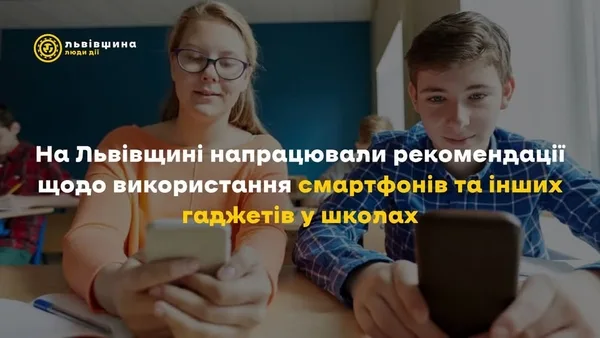
In Lviv region, methodological guidance has been developed on the use of smartphones and other electronic gadgets in general secondary education institutions. The document was prepared by the Department of Education and Science of the Lviv Regional State Administration, the Lviv Regional In-Service Teacher Training Institute and the Lviv Regional Student Parliament, as was announced at a briefing at the Lviv Regional Military Administration.
The guidance covers not only smartphones, but also tablets, smartwatches, headphones and other personal electronic devices that can transmit digital information over a distance. On its basis, each school will be able to develop its own local rules for the use of gadgets.
The director of the Department of Education and Science, Oleh Paska, stressed that the authors had deliberately rejected a blanket ban on gadgets. Before drawing up the document, they analysed the experience of schools and communities in Lviv region, as well as practices in other countries, and involved student self-government in the discussion.
“Our core belief is that for children, teachers and parents to follow this guidance, persuasion must be the way forward. The rules should be discussed in student parliaments, among parents, within the school teaching staff and at meetings of the pedagogical council. This is, in essence, the path to understanding,” noted Oleh Paska.
According to the guidance, during lessons sound signals and vibration on personal devices must be switched off, and the gadgets themselves should be kept in a rucksack, bag, briefcase or pencil case. Their use in class is allowed only with the teacher’s permission or at the teacher’s instruction and solely for educational purposes, in particular for working with electronic textbooks, interactive tests or QR codes.
Parents were separately urged not to call their children during lessons. In the event of a threat to life or health, a sudden deterioration in well-being or another emergency situation, a pupil may contact their parents directly. If necessary, this can also be done by a teacher, the duty administrator, the form tutor or a medical worker at the educational institution.