

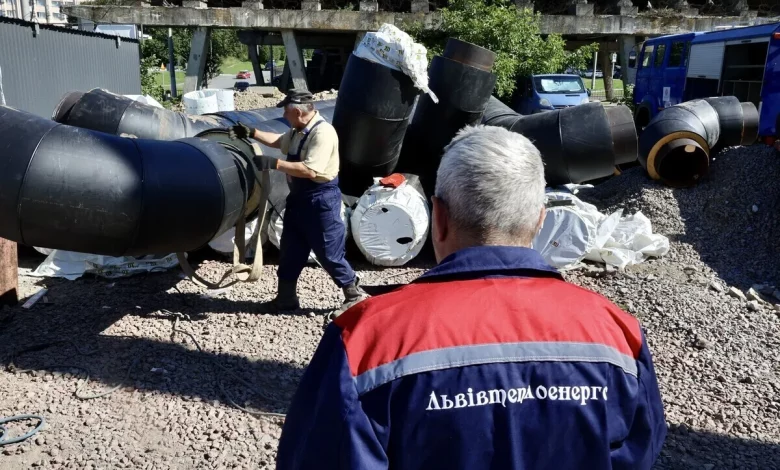
In Lviv, officials warn that a possible reduction in the share of reserved conscription-liable employees at heat supply companies from 75% to 60% could jeopardise the stable passage of the heating season. The risks to the operation of the city’s critical infrastructure were reported by the First Deputy Mayor of Lviv, Andriy Moskalenko.
On 13 October, the Cabinet of Ministers of Ukraine adopted a resolution amending the procedure for reserving conscription-liable citizens. According to the official, if the new rules are applied to Lviv Municipal Heat Supply Enterprise “Lvivteploenergo” and “Lvivvodokanal”, the companies will have to significantly reduce the number of reserved specialists who directly ensure the operation of the heat and water supply systems.
Moskalenko noted that the current reservation level at Lvivteploenergo and Lvivvodokanal is 75%. If the quota is reduced to 60%, Lvivteploenergo could lose reservations for around 90 employees, and taking into account compliance with the overall quota, for a further 70–80 people. Overall, this could mean the loss of up to 40–45% of the staff who work directly at heat supply facilities: preparing solid-fuel boilers for operation, maintaining heat networks, boiler houses and other critically important infrastructure.
“On the eve of the heating season, taking such decisions is extremely risky. The availability of specialists determines the stable operation of heat supply systems. We hope that the government will introduce appropriate changes that will prevent such consequences on the eve of the heating period,” said Andriy Moskalenko
Lviv Municipal Heat Supply Enterprise “Lvivteploenergo” is the main supplier of district heating in Lviv. The company provides heat supply to 2,137 multi-storey residential buildings with a population of over 503.8 thousand residents, as well as 67 healthcare facilities and 306 educational institutions. Its consumers include hospitals and medical centres where wounded servicemen receive treatment and rehabilitation, as well as other social infrastructure facilities.
According to the company, Lvivteploenergo employs 1,924 people, of whom 568 are conscription-liable. Currently, 426 employees are reserved, which is 75% of their number. These are mainly junior specialists – welders, fitters, and instrumentation and control specialists. If the reservation quota is reduced to 60%, reservations will have to be lifted from 86 employees just before the start of the heating season, which could lead to their dismissal and a further worsening of the staffing shortage.
The company stresses that it is already experiencing a lack of personnel due to the mobilisation of part of the workforce and natural staff turnover. The average age of employees is about 57. To maintain the heat supply system, specialists with appropriate education, experience and professional training are required, and their replacement demands lengthy training and the passing of qualification assessments.
Lvivteploenergo explains that training boiler operators, boiler house operators and combined heat and power plant engineers requires special permits and time. It is practically impossible to quickly find and train new employees who can ensure the uninterrupted operation of the heat supply system, especially at the beginning of the heating season, when equipment operates under increased load and rapid response to emergencies is critically important.
Similar concerns have been voiced by the Intersectoral Association “Ukrteplokomunenergo”. It notes that the staffing shortage is a systemic problem in the housing and utilities sector: on average, staffing levels are around 35%, and the average age of employees exceeds 55. At some companies this figure reaches 60 and above, which complicates preparations for the heating season, equipment maintenance and the rapid elimination of breakdowns.
The association emphasises that until the Cabinet’s resolution is officially published, it is too early to assess the specific provisions, but the very prospect of reducing the reservation limit is causing serious concern. In its view, at the start of the heating season, when stable heat supply to cities and communities depends on the coordinated work of specialists, decisions on reservations must be as carefully considered as possible.
At the same time, both Lvivteploenergo and the sectoral association underline the unconditional priority of defending Ukraine and meeting the needs of the Defence Forces. They insist that, when making decisions on reservations, it is necessary to take into account the specific nature of the work of critical infrastructure enterprises on which the population’s basic services depend.
The company and the association call on the government to maintain the reservation quota for heat supply enterprises at no less than 75% and not to reduce the limits for sectors that ensure the stable operation of life-support systems. In their view, this is necessary to retain qualified staff, ensure timely response to emergencies and guarantee a reliable heating season under martial law.