

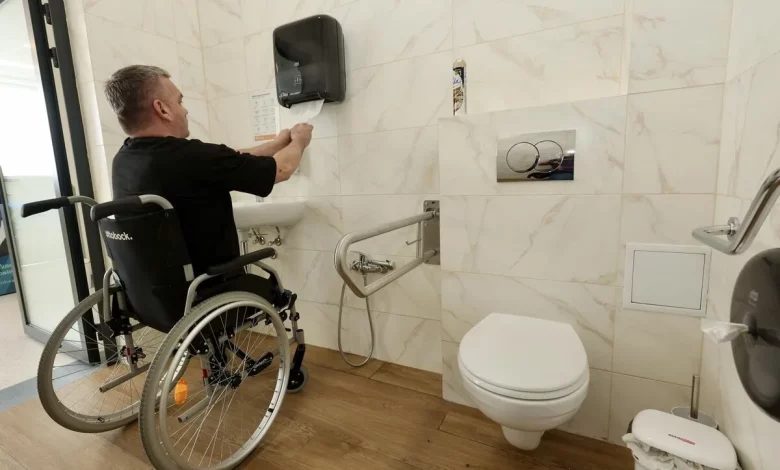
The Lviv community has approved recommendations on arranging step-free entrances and inclusive toilets in all venues across the city. The requirements apply both to municipal institutions and to private businesses. A video recording of the executive committee meeting has been made publicly available.
Lviv’s Deputy Mayor for Accessibility Iryna Maruniak stressed that the greatest accessibility problems arise at building entrances and in toilets. The recommendations were prepared by the Department of Architecture and the Accessibility Provision Office on the basis of numerous inspections of venues and institutions in the community.
According to Iryna Maruniak, the city systematically checks venues for compliance with accessibility requirements. As of now, there are 861 food service establishments operating in the Lviv community, of which 369 (43%) have already been inspected. A total of 42 venues (11%) have been recognised as fully accessible, 153 (42%) as partially accessible, while 174 venues (47%) remain inaccessible to visitors with limited mobility.
The best accessibility indicators have been recorded in the Shevchenkivskyi, Frankivskyi and Sykhivskyi districts. By contrast, Halytskyi district has the lowest share of accessible venues, which is linked to the fact that many facilities are located in listed buildings, where any alterations require additional approvals and bespoke design solutions.
During inspections, the most common violations identified are: inaccessible entrance steps, non-compliant ramps, high thresholds, narrow doorways, lack of handrails, call-for-assistance buttons and grab rails in toilets. Many premises lack sufficient space for wheelchair manoeuvring or have level changes within the halls.
At the same time, the city already has a number of positive examples where businesses take accessibility requirements into account at the opening stage. Such venues provide step-free entrances, accessible toilets, lowered reception counters and convenient seating for visitors who use wheelchairs. Among the accessible food service establishments are Kredens cafe (5 Valova St), MAD (10 Shevska St), MAMMA (99 Chornovola Ave) and others.
Among problematic examples, the decision specifically mentions the venue Kapital (50–52 Promyslova St) with inaccessible entrances, Doma (60 Shevchenka St) with non-compliant ramps, Shoco coffee shop (2 Sichovykh Striltsiv St) with high steps, Amadeus (7 Katedralna Sq) with inaccessible toilets, and Malenka Pekarnya (69 Zelena St), where the tables are set too high.
Iryna Maruniak underlined that an accessible food venue is a space of equal opportunities, where every visitor can feel respected, and for businesses this means expanding their customer base and increasing profits.
The Mayor of Lviv, Andriy Sadovyi, noted that the city must become fully accessible for all residents and visitors, including people with disabilities and those returning from the war. He recalled that positive changes are already visible in cultural institutions, government offices and some food service establishments, but the city’s task is to ensure accessibility of all such facilities.
The Mayor also recalled the co-financing programmes for arranging accessible entrances that Lviv is implementing with the support of the Icelandic initiative Ramp Up. The initiative is aimed at private venues and helps businesses to create step-free environments more quickly.
Under the executive committee’s decision, individuals and legal entities are recommended to arrange accessible entrances and toilets by 31 March 2027. Where there are objective reasons, this deadline may be extended by a further six months, subject to submission of a letter of guarantee.
According to data from the Lviv community, around 22% of its residents belong to groups with limited mobility. This is almost 148,000 older people, more than 30,000 people with disabilities, over 2,000 pregnant women and nearly 40,000 children under the age of six.
Every year, the city implements projects to improve accessibility: installing ramps and lifts in residential buildings and administrative premises, lowering kerbs at pedestrian crossings and driveways on main streets, and equipping pedestrian crossings with audible signals for people with visual impairments. Inclusive children’s and sports playgrounds are also being installed, and public transport stops, medical facilities and educational institutions are being made accessible.
Lviv is among the 15 cities in Ukraine where, together with the Ministry for Communities and Territories Development, the “Movement without Barriers” project to create step-free routes is being implemented. The city is developing a route almost 15 km long that will connect the Shevchenkivskyi and Lychakivskyi districts. Along this route, buildings, stops, parks and public spaces are being made accessible. In total, 48 facilities have been identified, with work completed at 34 of them in 2025 and the remainder scheduled for completion in 2026.
A separate focus area is support for higher education institutions and veterans. The city is ready to cover up to 50% of the cost of accessibility works in Lviv universities, as well as reimburse up to UAH 400,000 to veterans with disabilities for adapting their homes to their needs.
Plans for the current year include installing 29 ramps and 101 lifts in residential buildings in Lviv, replacing 9 lifts, and installing 3 battery-powered transporters and 1 backup power source to ensure uninterrupted operation of lifting equipment.
Video of the executive committee meeting discussing the accessibility recommendations: