

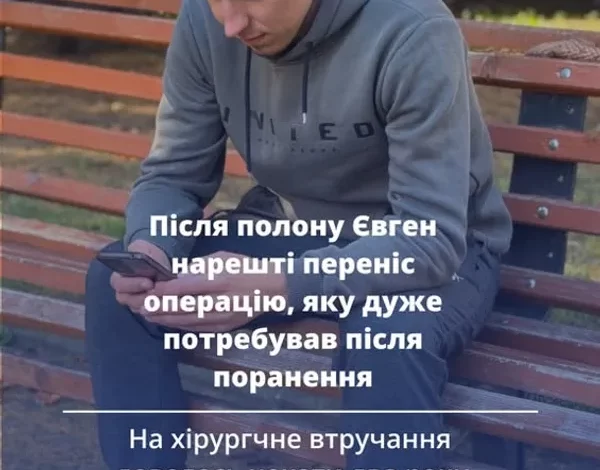
A 28-year-old serviceman of the National Guard of Ukraine from Lviv region, who spent almost two years in Russian captivity, has undergone complex reconstructive surgery on his lower jaw at the University Hospital. Due to a gunshot wound to the maxillofacial area, the man had long been unable to open his mouth fully, eat properly or speak freely.
Yevhen had been serving in the ranks of the National Guard since 2022. In 2024, during a mortar attack, he was wounded and captured. At first he was held in Sukhodilsk in Luhansk region, and later transferred to Orsk in Russia’s Orenburg region. In captivity, the wound was virtually not treated, so after returning home the serviceman was left with severe consequences of his injuries.
During this time, Yevhen lost hearing in one ear. Because the fragments of his lower jaw had fused incorrectly, he felt constant discomfort and could not eat or speak normally. The serviceman himself admits that while in captivity, he could not even think about treatment, as there was no certainty about the future at all.
“I didn’t think about it in captivity. There were no thoughts at all there. We knew nothing: whether anyone was waiting for you, whether there was anywhere to return to,” he says.
At the University Hospital, specialists from the Reconstructive and Plastic Surgery Clinic performed an operation aimed at eliminating the consequences of the wound and restoring the anatomical shape and function of the lower jaw. According to the head of the clinic, Yuliia Medvid, due to the lack of timely medical care, the bone fragments had fused in the wrong position, which led to deformity and impaired jaw function. During the procedure, the surgeons corrected the deformity and restored the proper alignment of the bony structures.
Doctors note that the operation was successful. Yevhen now faces a period of rehabilitation so that he can once again open his mouth without pain, eat properly, communicate freely and return to his normal life.
The greatest support for the serviceman is his family — his wife and three-year-old daughter. After being freed from captivity, the first thing he did was call his relatives, and now, while in hospital, he contacts them several times a day. After almost two years of uncertainty, the most important thing for him is to hear the voices of his loved ones and to know that they are waiting for him at home.
Yevhen’s story shows that the road to recovery for those released from captivity does not end on the day they return. They need long-term medical, psychological and social support to overcome the consequences of their time in captivity and their combat injuries.