

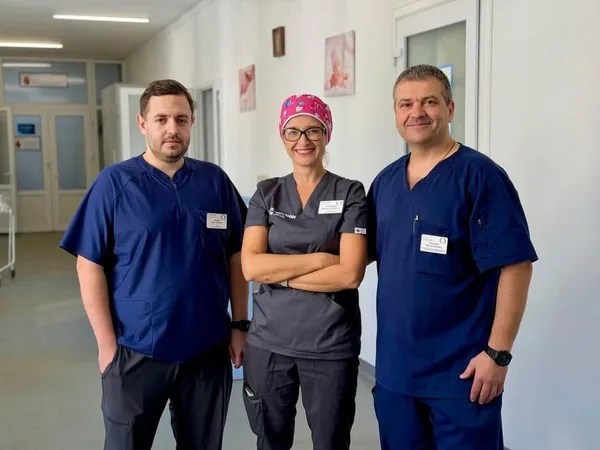
At the Centre for Paediatric Medicine, a multidisciplinary team of doctors saved 16-year-old Anna, who had been involved in a serious road traffic accident. During a family trip, the car in which the girl was travelling on the back seat collided with a lorry on a bend, and the main impact was on her side.
The teenager was treated in an extremely critical condition. Anna spent the first two days in the intensive care unit, where she was connected to a mechanical ventilator while the medical team fought for her life. After her condition stabilised and dangerous brain haemorrhages were ruled out, specialists from several disciplines were brought into her care.
The girl was diagnosed with multiple high-energy injuries: a closed traumatic brain injury, a fractured mandible, broken ribs and multiple fractures of the pelvic bones, including in the sacral area where important nerve structures run. The doctors emphasise that any displacement of the fragments could have resulted in loss of the ability to walk.
Under a single anaesthetic, the specialists carried out a simultaneous operation in two stages. First, the maxillofacial surgeons performed an open reduction of the mandibular fracture and its fixation. Then the orthopaedic trauma surgeons carried out a closed reduction of the pelvic fractures and fitted an external fixation device to securely stabilise the bone fragments.
“Pelvic fractures in children are rare, and with this level of severity and the need for surgery, all the more so. This was a classic high-energy trauma. Fortunately, we managed to prevent compression of the nerve roots and protect the girl from profound disability,” said Taras Moskal, orthopaedic trauma surgeon and Head of the Clinic.
Maxillofacial surgeon Khrystyna Pohranychna stressed that during such interventions it is important not only to restore anatomy and function, but also to minimise cosmetic consequences so that the injury does not affect the patient's future life.
Anna's condition has now improved significantly: she is moving her limbs, can feel them, and is under the close supervision of doctors and rehabilitation specialists, who started working with her while she was still in intensive care to prevent complications. A long period of recovery lies ahead which, according to medical forecasts, may last from six months to a year, but the main thing is that the girl has a chance to return fully to an active life.
Orthopaedic trauma surgeons Taras Moskal (Head of Department) and Mykola Liutkevych, maxillofacial surgeons Khrystyna Pohranychna and Roman Ohonovskyi, surgeons Bohdan Tsiupka, Nazar Havrylyshyn and Yosyp Novak, anaesthetists Vira Pryimakova (Head of Department) and Sofiia Kokhman, thoracic surgeon Olena Pohlod, nurse Tetiana Kachmaryk, as well as the emergency department team, CT technicians and rehabilitation specialists, all took part in the patient's treatment and rescue.