

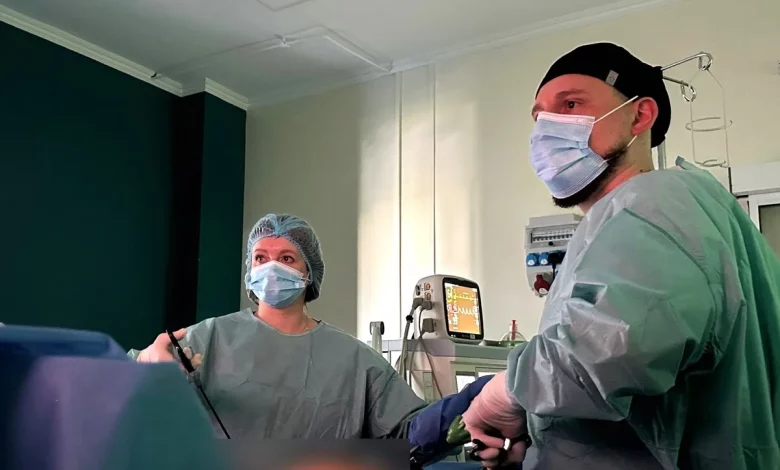
At St Panteleimon Hospital, part of the First Medical Association of Lviv, surgeons carried out a minimally invasive cancer operation on a 59-year-old patient with endometrial cancer, using an advanced technique for mapping sentinel lymph nodes with a fluorescent dye.
The woman, 59-year-old Nataliia Babii, had been experiencing intermittent bloody discharge for several years after the menopause, but kept putting off repeat visits to the doctor. When the symptoms worsened, she turned to specialists at St Panteleimon Hospital, where she underwent diagnostic hysteroscopy with endometrial biopsy.
Histological examination confirmed an oncological diagnosis: cancer of the uterine lining. The doctors proposed a total hysterectomy (removal of the uterus with the tumour) combined with mapping of the sentinel lymph nodes, in order to determine any possible spread of the disease through the lymphatic system of the pelvis.
Previously, in similar cases, surgeons often had to remove most or all of the lymph nodes in this area, which frequently led to persistent leg swelling and the formation of lymphatic cysts. The new navigation technology makes it possible to remove only the first nodes along the lymph drainage pathway from the tumour – the so-called sentinel or signal nodes, which are the first to which cancer cells may spread.
During the operation, a contrast agent – indocyanine green – was injected into the cervix. The laparoscopic camera was switched to a near-infrared mode, allowing the lymphatic pathways and nodes that had accumulated the dye to light up on the monitor and indicate to the surgeons the areas for precise removal.
According to gynaecological oncologist Oksana Pavliuk, who operated on the patient together with gynaecological oncologist Volodymyr Pyda, with the participation of anaesthesiologist Khrystyna Orlynska, the use of the special video camera mode and modern equipment makes it possible to reduce surgical trauma and meet global treatment standards.
The operation was successful: the doctors removed the uterus with the tumour and only those sentinel lymph nodes highlighted by the dye. This made it possible to avoid complications associated with the total removal of all nodes and facilitated postoperative recovery. Nataliia Babii was discharged home on the third day.
“Thanks to this contrast dye they removed only what needed to be removed, not all the lymph nodes. So I am very pleased. I thank the doctors. They saved my life. It is good that medicine is moving forward, that such equipment exists. Do not be afraid, go for check-ups. You have to go to the gynaecologist,” the patient says.
Doctors stress that such interventions, which are now considered the gold standard worldwide, are possible when the cancer process is detected at an early stage. They urge women not to ignore bloody discharge after the menopause and to have regular preventive examinations by a gynaecologist.
The First Medical Association of Lviv provides a full range of care for cancer patients – from advanced diagnostics and surgical treatment to rehabilitation. In addition to St Panteleimon Hospital, it also includes St Luke’s, St Nicholas and St Anne’s hospitals, the UNBROKEN rehabilitation centre and treatment and diagnostic centres.