

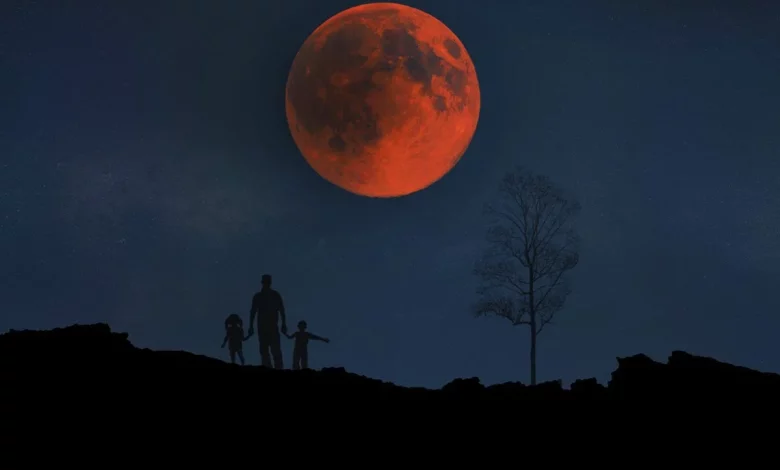
On the night of 27–28 August 2026 there will be a deep partial lunar eclipse, during which up to 96% of the Moon’s surface will be immersed in the Earth’s shadow. The event will be visible from most of North and South America, Europe and Africa.
According to BBC Sky at Night Magazine, the eclipse will unfold as follows in Coordinated Universal Time (UTC):
- start of the penumbral eclipse — 01:24;
- start of the partial eclipse — 03:34;
- maximum phase — 04:13;
- end of the partial eclipse — 05:52;
- end of the penumbral phase — 07:02.
To convert to local time, you need to add or subtract your offset from UTC. The article gives the following examples: PDT = UTC −7, MDT = UTC −6, CDT = UTC −5, EDT = UTC −4, BST = UTC +1.
Observers in North and South America are advised to look for the full Moon in the south-eastern part of the sky late in the evening of 27 August or around midnight, going into the early hours of 28 August. In Western Europe and West Africa, you should look for the Moon low over the south-western horizon before dawn on 28 August.
The author notes that the full Moon is easy to see with the naked eye, so it is enough to find it in the sky and wait for the eclipse to begin, when the disc will start to darken and take on a reddish hue.
The article also offers tips on how to photograph the Blood Moon with a smartphone. Specialists caution that taking pictures can distract from the experience of watching the event itself, but for those keen to get a shot they suggest a few practical steps.
It is recommended not to rely on automatic camera settings, but, if possible, to switch on a ‘night’ or ‘astrophotography’ mode. If such modes are not available, you should switch to manual or ‘pro’ mode, where you can adjust shutter speed, ISO and white balance.
To avoid blur, you should stabilise the smartphone as much as possible — mount it on a tripod or at least brace it against a wall or other solid support. This will help reduce any ‘trail’ from the Moon caused by hand shake.
If the observer has binoculars or a telescope, they can try so-called afocal photography — aligning the smartphone’s lens with the eyepiece of the optics. The article notes that this is quite difficult without a special adapter to attach the phone to the telescope.
Another tip is to lock the focus: to do this, bring the Moon into the centre of the smartphone screen, tap on its image and hold your finger there until the camera locks focus.
Particular emphasis is placed on setting exposure and ISO. A common problem is an overexposed disc, which appears in the photo as a white blob with no detail. At the start of the eclipse it is advisable to use a low ISO, and as the eclipse progresses and the Moon darkens, gradually increase the sensitivity.
The author advises against pinching to zoom in on the image on screen, as digital zoom only degrades quality. It is better to take a wider shot and then crop and enlarge it later on a computer in an image editor.
The article also notes that in poor weather, when the sky is overcast, observers can either wait for a break in the cloud or watch online streams of the eclipse instead.
The tips were prepared by science journalist Іain Todd, content editor at BBC Sky at Night Magazine, who has been writing about astronomy and space exploration for more than ten years.