

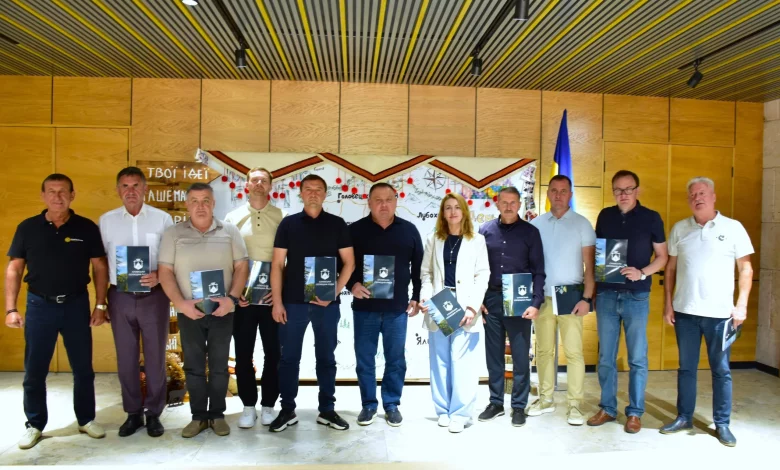
In the settlement of Slavske, a Memorandum on Cooperation and Joint Development of the Carpathian Region was signed. The partnership brings together eight communities from Lviv and Ivano-Frankivsk oblasts: Drohobych, Truskavets, Slavske, Skhidnytsia, Skole, Boryslav, as well as Vyhoda and Bolekhiv. Drohobych was represented at the signing by the Mayor, Taras Kuchma.
The memorandum is aimed at uniting the efforts of the communities in implementing economic, tourism, infrastructural, educational and environmental initiatives. Cooperation will take place in partnership with the NGO “Agency of Territorial Initiatives” and with the involvement of experts Maryana Oleskiv and Ihor Chava, who presented their vision for further interaction and outlined the key areas of joint work.
One of the central ideas of the new association is a shift from the isolated development of individual territories to coordinated planning at the level of the entire Carpathian region. The communities that have signed the memorandum are traversed by the “Carpathian Ring” – a national infrastructure project, but participants emphasise that roads alone do not shape a region without a shared vision, priorities and inter-territorial projects.
The communities are united by the natural resources of the Carpathians, the river network, tourist routes, cultural heritage and the “hospitality economy”. At the same time, they face similar challenges: transport accessibility, water supply, waste management, a shortage of qualified personnel, the seasonality of tourism, the consequences of climate change and the need for high-quality data to inform management decisions. The partnership is designed to strengthen each community by drawing on shared opportunities rather than through standardisation.
Planned areas of cooperation include the creation of inter-municipal tourist routes, implementation of joint infrastructure projects, training of personnel, attracting investment and grant funding, exchange of experience and joint promotion of the Carpathian region. The memorandum also provides for coordination of actions in the fields of local economic development, transport connectivity, housing and utilities, tourism, education, culture and local identity, environmental protection, support for young people, and the development of macro-regional and European cooperation.
Drohobych, as the largest town among the partners, may play a special role in the new association. The community has the potential to become one of the region’s educational and service hubs – particularly in training specialists for tourism, hospitality, culture and services. Particular emphasis is placed on making use of the town’s cultural and historical heritage. The Drohobych Saltworks, the oldest operating enterprise in Ukraine, is being considered as a potential flagship site on a joint Carpathian route, where history is combined with a modern tourism product and new economic opportunities.
After the official part, the delegations visited the site of the future GORO Mountain Resort, which is being developed in the Slavske community on an area of about 300 hectares within the villages of Volosyanka, Verkhnia and Nyzhnia Rozhanka. Acting head of the Slavske settlement, Oleh Danyliak, presented the progress of the investment project, the first phase of which is scheduled to open in 2027. The project envisages significant development of tourism infrastructure while at the same time introducing measures to minimise environmental impact: instead of the 70 hectares of forest to be cleared for construction, 240 hectares of new forest are planned to be planted.
For the participating communities, such initiatives serve as an example of a comprehensive approach to development – not only within administrative boundaries, but as a single tourism, economic and infrastructure system. The next stage of work will be the formation of a joint working group, the identification of priorities and the preparation of the first joint projects. Possible areas include tourism and promotion of the region, infrastructure, education and vocational training, environmental protection, work with analytical data, and attracting investment and grant funding.
The partnership remains open to other communities that identify themselves as part of the Carpathian region and are ready to engage in joint planning and shaping the future of this area.