

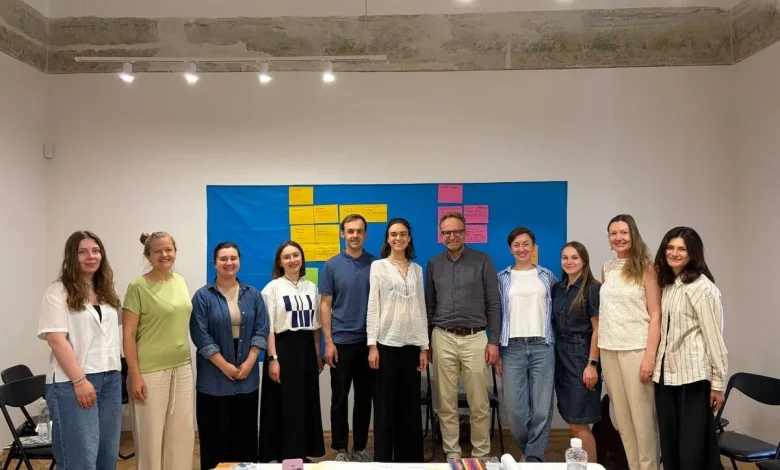
In Lviv, work has begun on preparing a concept for the reconstruction of part of Yurii Ruf Street. Urban planners, architects, international experts and structural units of the Lviv City Council are jointly working on a vision for the renewed space. The plan is that, once the project is implemented, this section will become an example of a comfortable, barrier-free and green urban environment.
The first workshop took place at the Eurointegration Hub as part of the project “Integrated Urban Recovery in Ukraine / Just and Green Urban Recovery Accelerator (JGURA)”. During the meeting, participants identified solutions to improve the safety, accessibility and convenience of the space for residents, and outlined the main stages for implementing the future demonstration project.
The team analysed the spatial characteristics of the area, reviewed successful examples of similar transformations in Ukraine and abroad, and discussed possible approaches to reconstruction. The ideas developed will form the basis of the concept for renewing part of Yurii Ruf Street and will make it possible to move on to the next stages of design.
Separately, participants agreed on further steps for developing the medical and educational quarter in Lychakivskyi district of Lviv. Those responsible for specific areas of work were identified, and ways of engaging residents and local institutions in shaping future decisions regarding the space were discussed.
As a reminder, in autumn 2025 the Lviv City Council signed a memorandum of cooperation with the JGURA project. The application to take part in the programme was prepared by the team of the Lviv Eurointegration Bureau together with the Department of Architecture and Spatial Development, the Lychakivskyi District Administration and the Deputy Head of the Department of Economic Development Oleksandra Sladkova.
The project “Integrated Urban Recovery in Ukraine / Just and Green Urban Recovery Accelerator (JGURA)” is implemented by Deutsche Gesellschaft für Internationale Zusammenarbeit (GIZ) GmbH on behalf of the German Federal Ministry for Economic Cooperation and Development (BMZ) and co-financed by the State Secretariat for Economic Affairs of Switzerland (SECO).