

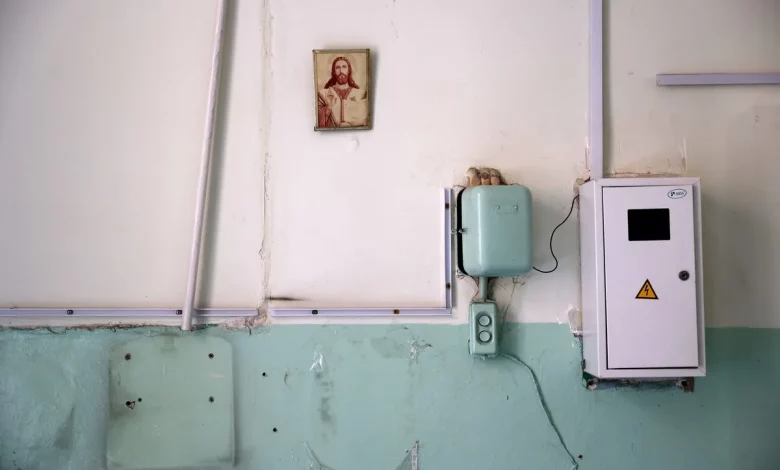
In Lviv, the building of the former 1st City Polyclinic at 20 Ruskа Street will not be given over to commercial use: after a major refurbishment, it will continue to provide medical services, and there are also plans to open a Centre for Research into Military Trauma with support from partners in the Belgian city of Mechelen.
The 1905 building, which is the communal property of the Lviv City Territorial Community and is on the books of Lviv’s First Territorial Medical Association, is currently empty: doctors have been transferred to other units, preparatory work for reconstruction is under way and design-and-cost documentation is being drawn up in order to attract funding.
According to Deputy Mayor for Humanitarian Affairs Iryna Kulynych, once the refurbishment is completed the premises will house a modern family medicine department, a facility for taking samples and conducting laboratory tests, as well as a large mental health department. On one of the floors they plan to set up the Centre for Research into Military Trauma; to establish it, the city is holding preliminary talks on funding with Mechelen, which has already supported a rehabilitation project on Zamarsynivska Street.
«I want to state publicly: there will be no hotels, restaurants, shops or other commercial premises in this building. It was, and will remain, a medical facility,» said Iryna Kulynych
During the reconstruction they plan to renew all utility networks, resolve problems with sewerage and electricity supply, and ensure the building is fully accessible. As explained by the director of the ‘Treatment and Diagnostic Centres’ branch of the First TMA of Lviv, Volodymyr Fedorov, it was impossible to combine receiving patients with large-scale repair works, and during blackouts it became clear that, due to the building’s technical features, the generator could power only one floor. Therefore, a decision was taken on a comprehensive reconstruction with complete replacement of the networks and internal restoration of the historic building.
Local resident Lidiia Fomina, who had been using this polyclinic for many years, admits that she was anxious about its closure, especially in wartime. After meeting representatives of the city, she noted that she supports the plans to restore the medical facility in this building, provided that medical staff continue to work here and residents can receive care in comfortable conditions.
The reorganisation of the institution had begun earlier because of how the then 1st City Polyclinic was operating. In March 2025, Lviv City Council decided to merge it with the 6th City Polyclinic in order to pool resources, reduce administrative costs and improve access to healthcare. In October 2025, all city polyclinics were integrated into territorial medical associations, and the former 6th polyclinic became part of the First TMA and now operates as the Pogulianka Treatment and Diagnostic Centre. Along with it, the building at 20 Ruskа Street was also transferred into the structure of the First TMA.
The review of the facility’s operations revealed a number of problems. As of November 2024, primary care doctors had only 11,910 patient registrations, whereas other large city polyclinics were serving 60–90 thousand. This low number of registrations meant significantly less funding from the NHSU, which made it difficult to maintain the historic building with a floor area of 4,683 sq. m and to modernise conditions for patients.
Another challenge was the lack of accessibility: the building is practically inaccessible for wheelchair users, patients with limited mobility, older people and parents with pushchairs. Because of this, family doctors were gradually moved to refurbished premises. At the time the reorganisation decision was taken, around 30% of staff were of retirement age; some doctors over 80 subsequently finished work.
Despite the changes, residents of central Lviv have not been left without medical care. Services have been moved to other units of the First TMA: on Rymlianyna, Fredra, Stetska, Uzhhorodska and other addresses in the city centre, so patients can choose locations convenient for them, rather than travelling only to Medovoi Pechery Street. The doctors from the medical centre at 20 Ruskа Street were not laid off: most of the 112 staff (52 doctors, 42 nurses, receptionists and junior staff) have continued working in the more modern premises of the First TMA.
The city is simultaneously upgrading other treatment and diagnostic centres. At the Mazepy TDC on 25 Mazepy Street, a former Soviet-era polyclinic has been transformed into a modern centre providing outpatient care, diagnostics, day-surgery and rehabilitation. Two additional floors made of wooden CLT structures have been added here, housing a rehabilitation department for patients of the UNBROKEN centre and local residents.
At the Sykhiv TDC on 68 Chervonoi Kalyny Avenue, a major refurbishment of the lobby and first floor was completed in early 2026: a new reception, waiting area, veterans’ room, mother-and-baby room, accessible toilet, ramps and lifts were installed, and wayfinding in the building was improved.
The Pivdennyi TDC at 4 Symonenka Street, one of the city’s largest outpatient facilities, already has an upgraded ground floor with a modern reception, waiting areas and energy-efficient windows. A new rehabilitation department and an external lift with seven stops for people with limited mobility are being created here.
At the Vyhovskoho TDC, the main lobby has been modernised, an on-call doctor’s and emergency conditions room has been created, and a separate consulting room for patients with symptoms of acute infections has been set up; new ultrasound rooms and a veterans’ support office will open soon. The upgraded A&E department is having additional rooms built, while the outpatient rehabilitation and radiology and functional diagnostics departments are being modernised in parallel.
The Levandivka Treatment and Diagnostic Centre is also undergoing active change: a modern space with a new reception and areas for patients is already operating, and wayfinding and accessibility features, an accessible toilet and improvements to the grounds, including widening of the ramp, are under way.
Since 1 May, city polyclinics have been operating as treatment and diagnostic centres within two medical associations of Lviv — the First and the Second. The structure of the First medical association includes the Mazepy, Pivdennyi, Sykhiv and Pogulianka TDCs, while the Second comprises the Levandivka and Vyhovskoho TDCs. Appointments can be made via the reception of the relevant centre, the phone numbers of the medical associations, the Helsi system or online on the websites of the First and Second medical associations.
A video about the city’s plans for the building at 20 Ruskа Street and the modernisation of the network of treatment and diagnostic centres has been published on YouTube: