

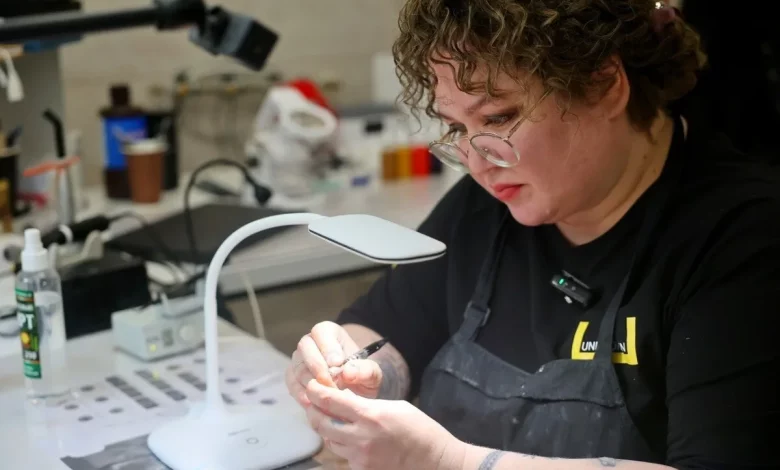
For about six months now, an anaplastologist, Taisiia Yarova, has been working at the UNBROKEN Centre in Lviv, creating bespoke prostheses for eyes, noses, ears and fingers for Ukrainian servicemen who have sustained severe injuries. Her work helps veterans not only restore their appearance, but also recognise themselves in the mirror again.
Anaplastology is an extremely rare speciality that is only just emerging in Ukraine, although this field has long been developed worldwide. In Taisiia’s workshop, amid plaster moulds, paints, silicone and improvised tools, each prosthesis is made by hand, carefully reproducing the shape, skin tone, pigment spots, eyelashes and other tiny details. In six months of work in Lviv, the craftswoman has created more than 30 bespoke prostheses for servicemen.
One of her patients is 35-year-old veteran Pavlo Martsenyuk, who lost his sight after being wounded. For him, the UNBROKEN Centre created a custom eye prosthesis that looks as close to real as possible. Pavlo was particularly looking forward to this moment, as he wanted to surprise his daughter Anastasiia and attend her graduation from nursery school. During the final fitting, he admits that thanks to the prosthesis he feels more confident and hopes that people will stop looking at him with pity.
Taisiia Yarova is the only anaplastologist at the UNBROKEN Centre. In her work she combines knowledge of medicine, artistic techniques, sculpture and psychology. There are no dedicated training programmes in Ukraine, so she gained experience by consulting specialists from the USA, Sweden and Israel. The craftswoman moved to Lviv from Kryvyi Rih, where she worked in the beauty industry and as a dental technician. Having seen an announcement about the search for an ocular prosthetics specialist, she decided to change city and devote herself to helping servicemen.
At the same time, Taisiia is studying for a Master’s degree at Lviv Polytechnic in bioengineering and technologies for manufacturing orthopaedic and rehabilitation products, because, as she says, technical training is also important for this work. To create prostheses, she uses medical-grade platinum silicones and certified dental materials that are safe for prolonged contact with skin and mucous membranes. Facial prostheses are usually worn from 5 to 8 hours a day, after which they must be removed and cleaned.
The process of making a single prosthesis takes from two to three weeks, sometimes longer. For each patient, an individual technical solution is sought: the method of attachment is considered, and the characteristics of the skin, facial expressions and facial structure are taken into account. The craftswoman creates silicone covers – a kind of “artificial skin” that reproduces as accurately as possible the lost parts of the face or hands. She stresses that such prostheses must look as natural as possible, because people come with the hope of seeing themselves as they were before the injury.
At the same time, the requests of servicemen vary. Some ask not to make the eye prosthesis too realistic, so that those around them understand that the person cannot see, and do not limit themselves to just pointing with a hand when asked to help them orient themselves in the street.
Taisiia says the hardest part of the job is not the technical challenges, but the daily confrontation with stories of war – pain, loss and long recovery. She admits that she lives through each story together with the patients and their families, and strives to help them return to life not only physically, but also psychologically.
The war has also taken someone close to her: her nephew, master sergeant Vladyslav Malysh, call sign “Tor”, who had been fighting since 2014, was killed at the front. It was this loss that finally convinced Taisiia to stay in Ukraine and work for wounded defenders, despite the opportunity to go abroad.
The inner strength of the servicemen, their resilience and their desire to go on living despite severe injuries, make a deep impression on the craftswoman. She considers the greatest reward for her work to be the moment when a patient looks at themselves in the mirror for the first time with a new prosthesis and recognises their own face again, can calmly go outside and not pay attention to the glances of passers-by.
Taisiia is convinced that society must change its attitude towards people who have returned from the war: instead of pity, they need respect, support, understanding and gratitude. She recalls the words of one volunteer patient, who stressed that he had gone to war consciously and understood all the risks, including the possibility of being killed. This conversation, according to the craftswoman, changed her view of how defenders should be treated.
In her workshop, Taisiia works alone, but does not hide that an assistant would be very welcome. She hopes that in time her daughter, who is studying medicine and has already taken an interest in her mother’s unique profession, will join this work.
A video story about the work of Taisiia Yarova and the veterans whose faces are being restored in Lviv after injuries can be viewed at the link: https://www.youtube.com/embed/rhqxWNiCMgk?feature=oembed