

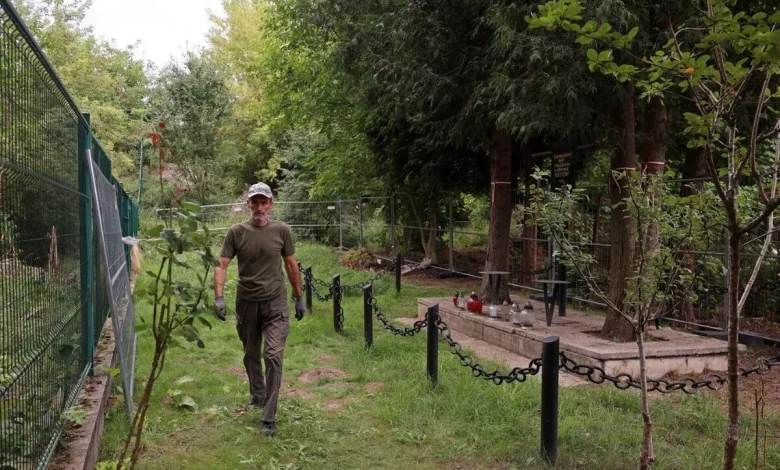
In Lviv, on the grounds of the old Holosko Cemetery near Kruhla Street, exhumation has begun of the remains of Polish Army servicemen who were killed in the fighting for the city in September 1939. The works started on 25 August and will continue until 1 October. According to historians’ preliminary estimates, around 120 soldiers may be buried in this section. The discovered remains are to be reinterred at the cemetery in Mostyska.
The search and exhumation works are being carried out by joint expedition teams from the Ukrainian Society for the Search for Victims of War “Pamyat”, the Institute of National Remembrance of Poland and the Ukrainian Institute of National Remembrance. Around 30 specialists from the Ukrainian and Polish sides are involved. Part of the area where the excavations are taking place belongs to Lviv City Council, the other part to a neighbouring religious community. The city is responsible for preparing the site, ensuring safety and maintaining public order.
At a briefing, the Head of the Office of the Executive Committee of Lviv City Council, Yevhen Boyko, reported that this is already the second stage of the search and exhumation works: the first took place in 2025 on the grounds of the former cemetery in Zboishcha. He stressed that all works at Holosko Cemetery are being carried out on the basis of permits issued by the Ministry of Culture of Ukraine and within the framework of current procedures, and that they are also an important gesture in relations between Ukraine and Poland and contribute to the study of shared history. According to the official, Lviv City Council has provided full support for organising the process, including preparing the site over the past two weeks.
Dominika Siemińska, a representative of the Institute of National Remembrance of Poland, noted that the Polish side is satisfied with the conditions for carrying out the works in Ukraine and has obtained all the necessary permits. She expressed the hope that it would be possible to recover the remains of all the buried servicemen and to carry out their reburial at the cemetery in Mostyska.
Liubomyr Horbach, head of the Society for the Search for Victims of War “Pamyat”, explained that the burials at the old Holosko Cemetery are individual. They are arranged in three rows, with approximately 40 graves in each, about 45 metres in length. According to him, the fact that each soldier has a separate grave indicates that those who carried out the burials had the time and opportunity to dig individual plots. It is possible that the bodies may be in coffins. Testimony shows that the German administration, which was then stationed on these hills, allowed local residents, including captured Polish soldiers, to retrieve the bodies of the fallen and bury them in cemeteries.
Among the buried servicemen were not only Poles, but also Ukrainians and representatives of other nationalities who served in, or had been mobilised into, the Polish Army. During earlier excavations in Lviv, search teams found identity tags with Ukrainian surnames and indicated religious affiliation — Orthodox or Greek Catholic — as well as personal belongings, including a small mirror with a portrait of Ivan Franko. This, according to Liubomyr Horbach, confirms the participation of Ukrainians in the common struggle together with Poles and other nations against Nazi Germany and the Soviet Union.
The further identification of the recovered remains was outlined by Tomasz Trzaska, a representative of the Institute of National Remembrance of Poland. He said that specialists will collect bone material and other items associated with the dead, after which each set of remains will be placed in a separate coffin and sent for examination. DNA analysis will be used to establish identities. The Institute has a database of around 5,000 genetic samples, compiled on the basis of recovered remains and data provided by relatives of the fallen, and uses the CODIS system, which makes it possible to carry out identification even in complex cases.
The exhumation at Holosko Cemetery is being conducted in accordance with permits from the Ministry of Culture of Ukraine, decisions of the State Interdepartmental Commission for the Perpetuation of the Memory of the Victims of Wars, Political Repressions and Participants in the Anti-Terrorist Operation, and with the consent of the Ukrainian Institute of National Remembrance. It is based on applications submitted by the NGO “Society for the Search for Victims of War “Pamyat” and official letters from the Polish side.
The first studies on the grounds of the old Holosko Cemetery were launched by the Polish Institute of National Remembrance back in 2010. In 2019, the search works were continued jointly with the “Pamyat” Society and the Lviv Children’s Scout Troop “Barć” of the Polish Scouting and Guiding Association in the Western Regions of Ukraine. At that time, it was possible to finally define the boundaries of the military cemetery, after which the Ukrainian side prepared and submitted to the State Interdepartmental Commission in Kyiv the documents required for the exhumation to be carried out by the Polish side.
The next step after the research was to have been exhumation, but the process was delayed and could only be reinvigorated after the gradual renewal of Ukrainian-Polish dialogue on historical memory. In 2024, the “Pamyat” Society approached the Ministry of Culture of Ukraine with an initiative to resume works related to the preservation of Polish military burials from 1939 in Lviv. Following an official approach from Polish institutions in 2025, the project moved into practical implementation.
The first stage of the exhumation and reburial of Polish Army soldiers who died in the defence of Lviv in 1939 took place in August 2025 on the grounds of the former cemetery in Zboishcha. The joint Ukrainian-Polish expedition lasted more than four weeks and resulted in the discovery of the remains of 34 soldiers. The current works at the old Holosko Cemetery are a continuation of this long-term joint project to honour the memory of fallen servicemen.
Video from the site:
Watch the video of the exhumation works at the old Holosko Cemetery in Lviv