

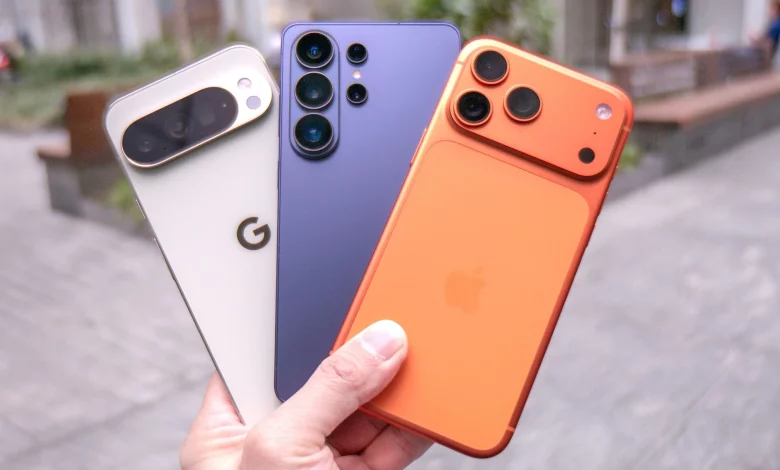
Respected outlet Tom’s Guide has published an updated ranking of the best smartphones of 2026, analysing dozens of models across different price brackets. Based on the test results, the overall leader was the iPhone 17 Pro Max, while the best Android smartphone was named as the Samsung Galaxy S26 Ultra.
The ranking was compiled by senior smartphones editor John Velasco together with colleagues James Frew and Richard Priday. In their reviews, the experts took into account performance, battery life, display quality, camera capabilities, artificial intelligence features and overall value for money.
In the “best smartphone overall” category, first place went to the iPhone 17 Pro Max. Reviewers highlighted the new two-tone chassis design, the A19 Pro processor with a vapour chamber for cooling, the bright OLED display with a 1–120 Hz refresh rate, and the triple 48 MP camera with an improved telephoto lens. In the battery life test, the device lasted almost 18 hours on a single charge, setting a record for an iPhone. On the downside, they pointed to the high starting price of $1199 and the lack of notable new AI features in Siri at launch.
The title of best camera phone went to the Samsung Galaxy S26 Ultra. The smartphone is equipped with a 200 MP main camera, two telephoto lenses (50 MP with 5x optical zoom and 10 MP with 3x zoom) and a 50 MP ultra-wide module. According to Tom’s Guide, this model delivers the best results when shooting at high zoom levels, and also offers video stabilisation with Horizon Lock. The reviewers also singled out the Privacy Display mode, which makes it harder for people to peek at your screen, along with an expanded suite of AI features based on Galaxy AI and Google Gemini solutions. Among the drawbacks are the larger camera bump and a slight reduction in display brightness due to the privacy screen technology.
In the sub-$500 segment, the top spot went to the Google Pixel 10a. Priced at $499, the smartphone offers a 6.3-inch OLED display, a Tensor G4 chip, a 5100 mAh battery and a 48 MP main camera with an additional 13 MP ultra-wide module. Reviewers emphasised the improved battery life (over 15 hours of web browsing) and support for Google’s signature AI tools, including Camera Coach and Auto Best Take. At the same time, the device retains the previous camera hardware, so there is no noticeable leap in photo quality compared with the Pixel 9a.
The editorial team named the iPhone 17 the best-value iPhone. The model features a 6.1-inch 120 Hz OLED display and an A19 processor, starts with 256 GB of storage and is priced from $799. The smartphone comes with a 48 MP main camera and a 48 MP ultra-wide module, and supports Apple Intelligence, MagSafe and Dynamic Island. According to the tests, the battery delivers around 12 hours and 47 minutes of use. On the negative side, reviewers mentioned middling zoom capabilities due to the lack of a dedicated telephoto lens and a relatively modest number of new AI features compared with the Pro versions.
In the battery life category, the top spot went to the gaming-focused Asus ROG Phone 9 Pro. The smartphone, with its Snapdragon 8 Elite processor, 6.78-inch display (up to 185 Hz) and 5800 mAh battery, delivered one of the best results in Tom’s Guide’s testing history — 20 hours and 34 minutes of use. It supports 65 W fast wired charging, wireless charging and a bypass charging mode to reduce heat during gaming sessions. However, reviewers draw attention to the high starting price of around $1100, limited software update support and average photo quality compared with modern flagships.
As the “best flagship without a Pro or Ultra suffix”, the outlet singled out the Google Pixel 10. At $799, the smartphone offers a triple-camera system with a 10.8 MP telephoto lens and 5x optical zoom, the new Tensor G5 chip, a brighter display and an expanded set of AI tools: Magic Cue, Voice Translation, Ask Photos and more. In the battery life test, the Pixel 10 lasted 13 hours and 13 minutes. Although in raw performance the Tensor G5 trails rivals based on the Snapdragon 8 Elite, the editorial team did not encounter any speed issues in day-to-day use.
The best foldable smartphone, according to Tom’s Guide, is the Motorola Razr Fold. Starting at $1899, the model is equipped with an 8.1-inch inner flexible display and a 6.6-inch outer screen, a Snapdragon 8 Gen 5 processor, 16 GB of RAM and a triple 50 MP camera array (main, ultra-wide and 3x telephoto). Test results show the smartphone delivers more than 14 hours and 40 minutes of use and supports 80 W fast wired charging. Reviewers stressed the robustness of the hinge and the overall durability of the design, but noted that its AI capabilities are more limited than some rivals and that switching between the inner and outer screens can be somewhat awkward.
To qualify for the ranking, all models go through Tom’s Guide’s standard testing procedure. In the lab, they measure display brightness, colour gamut and colour accuracy, run synthetic benchmarks such as Geekbench and 3DMark, and carry out real-world tests such as video transcoding in Adobe Premiere Rush. Battery life is tested separately using continuous web browsing, and the cameras are assessed under various lighting conditions.
Based on this year’s results, Tom’s Guide’s reviewers conclude that competition between manufacturers has intensified, particularly around AI features and cameras. At the same time, most flagships priced from $799 show clear progress in battery life and charging speeds, although the Asus ROG Phone 9 Pro still holds the overall battery life crown.