

Truskavets, Boryslav, and Drohobych communities are implementing a biogas pilot project.
Truskavets, Boryslav, and Drohobych communities, in collaboration with the municipality of Watlingen (a partner city of Truskavets in Lower Saxony, Germany), are carrying out the pilot project ‘Securing the Future Together: Development of Innovations in Biogas Use through Intermunicipal Cooperation in Truskavets, Boryslav, and Drohobych’ within the program ‘Green Industrial Recovery through Community-Based Development in Ukraine’.
The grant application from Truskavets was submitted by the mayor’s advisor Ruslan Prystai. The project will be implemented until December 2026. The key goal is to ensure capacity and create a foundation for sustainable biogas production for the three target communities of Lviv region, Ukraine.
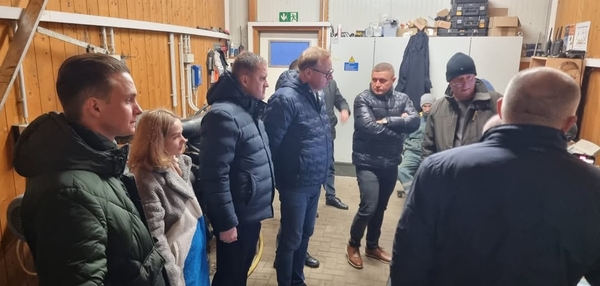
As part of this project, at the end of November, Truskavets’ Mayor Andriy Kulchynskyi and his deputy for housing and communal services Oleksiy Balytskyi, along with representatives of Boryslav and Drohobych communities, made a working trip to Germany.
During this trip, the former head of the Watlingen community, Wolfgang Grube, donated 2,000 euros collected at a charity fair, with which multimedia equipment was purchased for the ‘Teremok’ kindergarten, as we have previously reported.
The visit took place within the framework of the international project by the United Nations Industrial Development Organization (UNIDO) ‘Biogas at the Municipal Level – Lessons from Germany’.
Energy efficiency and energy saving are among the priorities of our country, and today it is a matter of national security. For many years, Ukraine was energetically dependent on Russia, which blocked the development of our energy resources potential. As a result, we observe the weakness of the energy system, especially during shelling. It can be strengthened by using alternative energy sources: sun, wind, biomass. Germany has many years of experience in energy efficiency, particularly in the use of bio-waste.
The trip participants visited three plants where they got acquainted with the operation of biogas installations. Furthermore, the company owners conducted a training seminar, where they detailed the economic, energy, and technological aspects of bio-waste processing.
During the visit, there was also an acquaintance with other Ukrainian communities; the participants shared the history, features, and advantages of their territorial communities.
Within the framework of the UNIDO project, a roadmap for waste management will be developed for the three communities that participated in the trip, as well as initial calculations regarding the possible construction of biogas plants in the region.
Several options are being considered for the placement of the biogas plant, particularly at the junction of the three communities (between Modrychi, Boryslav and Mlynky), in the village of Dobrohostiv in the Truskavets community, and there are other options as well. This is a long-term prospect after the war ends and requires additional study and discussion with the residents of these areas. Meanwhile, the currently implemented project is a soft one, which involves exclusively educational trips, seminars, workshops, conferences, rather than direct construction of a biogas production plant.
The trip to Germany provided practical knowledge and laid the foundation for international cooperation and development in the field of alternative energy in our community.
The Truskavets City Council expresses sincere gratitude to UNIDO Ukraine, the UNIDO BIOGAS project team for organizing the educational trip and facilitating the implementation of innovative energy solutions, and to the municipal and partner community of Watlingen for their support of Truskavets, Ukraine, and our projects and initiatives.