

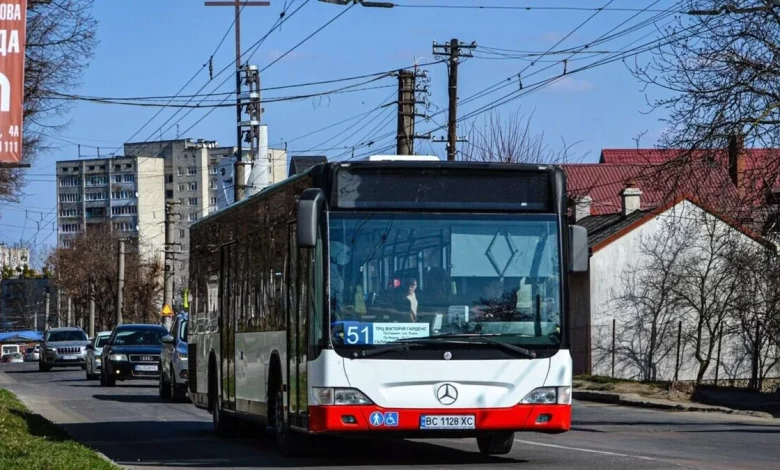
Lviv continues to modernise its transport system and street infrastructure: almost 95% of payments on city transport are now cashless, most of the fleet is accessible for passengers with limited mobility, and all 177 traffic signal installations are equipped with backup power. This was reported by the Director of the Department for Urban Mobility and Street Infrastructure, Oleh Zabarylo, according to Lviv City Council.
According to the official, one of the key priorities remains the development of public transport. The city is expanding its route network to better cover the municipal area. A new bus route No. 67 has recently been launched to serve Briukhovytska Street. Route No. 33 has also been extended to Puliuia Street, and earlier Route No. 21 was extended to Malogoloskivska Street.
The fleet is being modernised in parallel. The municipal bus operator has replaced buses on almost all its routes, with only Route No. 45 still to be updated. Private operators are also gradually bringing in new buses. In total, there are currently 410 buses adapted for people with disabilities operating on city routes, compared with 285 in 2025. Electric transport is also becoming more accessible: the city already has 99 such units in service. As a result, over 80% of all city transport is suitable for carrying people with limited mobility.
The department is also focusing on service quality. Transport department specialists constantly monitor vehicle deployment on routes, the sanitary condition of interiors, the operation of air conditioning systems, and compliance with safe boarding and alighting rules. Correct bus approach to the kerb or platform is a mandatory requirement in contracts with operators. Thanks to daily monitoring and awareness-raising, the share of correct stops has increased from 20% in April to 80% in September.
According to Oleh Zabarylo, operators face financial penalties for failing to meet these requirements. A similar approach is applied to other quality indicators — the operation of air conditioning, cleanliness in vehicles, and delivery of the contracted number of trips. As a result, the number of passenger complaints has fallen significantly, and, according to the department, reports of drivers refusing to stop for passengers entitled to concessions have virtually disappeared.
The share of cashless payments on Lviv’s public transport is growing rapidly. While in December 2023 they accounted for 12%, and during 2025 around 65%, as of July 2026 this figure had reached almost 95%. Only about 5% of journeys are paid for in cash — mainly by visitors to the city and people who use transport infrequently. Around 450,000 journeys are made on city transport every day. Residents are being encouraged to go cashless through season tickets, free transfers and other incentives.
Another separate workstream is the development and energy independence of traffic light infrastructure. The city has 177 traffic signal installations, with around 2,500 individual traffic lights. Of these, 157 are connected to a unified traffic control centre, which allows their operation to be adjusted remotely. Whereas in 2022 only one installation had backup power, now all traffic lights are equipped with it. In the event of a power cut they can operate autonomously for between 12 and 36 hours, depending on the specific location.
Another important area is traffic management and tackling congestion. Specialist staff analyse data from CCTV cameras and GPS systems to identify locations where both public and private transport are being delayed. Based on this information, the traffic safety commission takes targeted decisions on measures such as creating additional traffic lanes, changing traffic directions or introducing other engineering solutions to relieve pressure on problematic sections of the street network.
To build a single digital database of Lviv’s road infrastructure, the city has secured international funding. It has been included in the list of 14 European cities selected for the RAPTOR 2026 programme by EIT Urban Mobility. As part of this project, Lviv will receive a digital platform and specialised equipment for scanning streets. The equipment will automatically collect data on road signs, traffic lights, road markings and the condition of the road surface, so that district administrations have an up-to-date digital map at their disposal and can plan works effectively. The project is scheduled to be implemented in the second half of 2026.
In conclusion, the Director of the Department for Urban Mobility and Street Infrastructure stressed that the city authorities will continue working to improve the accessibility, safety and convenience of Lviv’s transport system for all passengers.